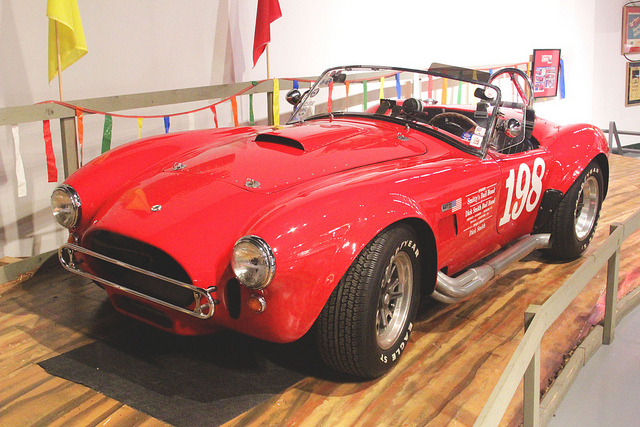
Wednesday, February 8, 2017

This is Not Going to End Well Part III

This is Not Going to End Well Part III
The Aftermath
Seeing your wife and children in shock and tears through the back window of an ambulance, if you're not a total fool, is one of the most sobering things that can happen to you.

I don't remember walking...I guess I walked...from the car to the ambulance. I do remember sitting on the stretcher and answering questions that seemed a bit surreal. Of course I knew who I was, and what day it was, and where I was. I did realize this was part of the EMTs' normal checkout procedures, but it still seemed almost satirical somehow.

It was a slow ride back to the paddock and my pit. I'm not sure they had brought the battered hulk of the car back yet, but I quite clearly remember Sherri rushing the ambulance and pulling the back door open. An attendant gruffly told her I was ok but they were not through with me yet...and then literally pushed her back and closed the door. While he continued to question me I could see her as well as both kids through the window. The picture is etched in my mind forever, and in it the kids are...still kids.

Someone later made the comment that the incident must have been scary. I replied that that emotion was about the only thing which was not going through my head while it was happening. Ans after I was exhausted and depressed, but that was about the extent of what I was able to feel. And while I do have photos that two people took of the car after the incident, I am not going to share them with anyone including this blog. Suffice it to say that there was no longer a single untouched panel on the car, and that two of the wheels were broken.

My “recovery” began when we left the track. We were staying at John Lewis's place in Windsor, and we took a shortcut off Highway 37 to avoid 101, called the “Lakeville Highway.” It passes rolling farm and pasture land, and another permanent memory is the setting sun reflecting off a red barn in a bright green field (it was Spring, remember...the only time in California that grass is anything but golden brown)...with two chestnut horses grazing nearby.

“God,” I thought, “It's good to be alive.”

I knew that Sherri and John had conspired to drive me to a hospital to be checked out...mainly to verify that I was not bleeding internally or something like that...probably a reasonable precaution though I did feel a bit silly explaining to a baffled emergency room physician why I was there and what had happened.

After that I needed to regroup. Sherri strongly urged me to sell the car immediately, which I knew was not the right move. For one thing it was worth nothing as a wreck. But the bigger issue was, as I told her, I needed to get back in it and race it at least one more time. I feared that if I didn't I would not only regret my cowardice for the rest of my life, but that it might freeze me with fear in other areas, including the far riskier situation we ignorantly face on public roads every time we turn the key in a car.

But I shoved the car in a shed I had originally built for Jason's Crosley...and did not open the door again for six months. I really need to think things through. Why had I gotten into racing to begin with? What did I get out of it? How much did it really mean to me and how much risk was I willing to take?

Then I accepted Peter Giddings kind offer to move it to his place in Alamo and for John deBoer, who was working for him at the time, to begin to bring it back from near death.
If you have ever read a vintage racing magazine or been to practically any vintage race in the world there is a very good chance you know who Peter is, or at least know his cars. He's another of those wonderful souls I've met through cars and about whom there will be other stories as this blog develops, but you can get a solid non-personal preview here:http://petergiddings.com/. Pretty heady stuff, eh?

John was doing great work on the car, but it was going slowly. He was sensitive to the car...managing to pull out the totally crushed front fender. I had asked Jack Hagerman to look at it, as John was only able to work on it in his spare time. Jack said I had better get it away from John before he “ruined it,” pointing to the fact that the redone fender had an edge where it joined the hood surround which was sharper than the one on the other side. Jack wanted to scrap the original metal and build a new fender. John was trying to save as much of the original car (actually all of it) as possible.

I did not like Jack's answer nor that he disparaged someone else's work. I looked closely at a photo I had of the car taken on the day it was picked up from Otto Linton in 1952...and that difference between the sides was clearly visible. These cars were hand built, after all, without computers, by workers hammering metal over, at best, wood forms, and at worst a bag full of sand. Clearly Guido and Giovanne weren't talking to each other as they worked on either side sculpting the car in Torino.

Next Ernie had me take it to Kent White in Nevada City. Known as the “Tin Man,” he had done body work for Bill Harrah. While more than competent, like many in the restoration world, Kent somehow sort of drifted out of business competence, and among other odd things he did, somehow managed to lose the original door inserts I brought him so he could use them as templates to correct the dented doors. Ernie advised me to get the car from him before anything else went wrong.

Ernie and his neighbor then finished the body work and the car was painted in his neighbor's garage. John had provided me an “incentive” to finish it by August...he had been asked to put together a non-judged display of various Siata models for Pebble Beach and wanted mine as the sole 300BC.

Wow.

The only issue was...this was four years later. That's how long the rebuild took. Meantime the fear I did not experience during and after the wreck kind of crept in. I was OK on the street, but the couple of rides I took with friends on the track made me very uncomfortable. But I always think it is tougher to be a passenger than a driver and put at least some of my nerves down to that. I recall when I was going to New York on business riding in a cab was terrifying, but when I drove in Manhattan in my rented car it was no problem.

I figured out quickly what the rules were:
  1. Never be influenced by the guy behind you blowing your horn
  2. Don't look in the rear view mirror. Anything that far back will take care of itself
  3. Right turns on red are illegal in Manhattan, so the only way to get around the corner is to start moving as slowly as possible as soon as your light turns green. The sea of pedestrians who immediately step off the curb to cross the street will just flow around your car without problem
  4. Lane markings mean nothing. There will be a truck unloading blocking 1 ½ lanes anyway. Just drive side by side with as many cars as will fit the roadway
The problem riding in a cab is that you can actually see all this mayhem going on around you. When you're driving it is invisible to you.

Gary Winiger and Ernie were worried about me, and conspired to have me co-drive a two hour enduro with them at Sear Point in Gary's Siata. This was a bit of a confidence builder, but limited. With this and my own return to racing I found my driving skill was not a concern...but for two years or so after I could not go into a fast turn without a second of “heart freeze” wondering what might break, fall of the car, and kill me.

Though John had selected the cars for Pebble, the Head Judge had the final call. My conversation with him was a bit peculiar.
“Is the car red?”
“No, it's blue.”
“Good, we have too many red cars.”
“They're Italian, for heaven's sake.” (I thought this but didn't say it).
“If you have a roll bar is it removable?”
“Yes.” thinking it is not the easiest thing to remove.
“Good, we would like it displayed without it. What color are the seatbelts?”
What color are the seatbelts? “Black.”
“Good. Does it have braided oil lines and if so would you paint them?”
“NO!!!!” This madness has to stop. It's a race car!

I was deeply honored for this invitation to what is the most prestigious car show in the world. It was also one of the most boring days I've ever had with a car.

My race group at Monterey runs on Saturday in alternating years, and on Sunday in between. Fortunately in 1991 we ran on Saturday. That evening Adin and I pulled the roll bar out, so when we got to the venue and drove in all we had to do was a quick polish to remove the track grime. It was literally a ten minute “spit shine” of the car. Adin had borrowed a video camera and later in the day a woman looking at the car remarked that “they must have spent all night cleaning it.” You can hear Adin giggling on the recording.

But he laughed even harder when Ralph Lauren's people arrived with a Bugatti trailer queen. Two guys in white lab coats then jumped out and began brushing grass blades out of the tire treads with makeup brushes. Adin was laughing so hard he was in tears.

Spectators were very polite..and totally intimidated. A father kept admonishing his seven year old daughter over and over again..”don;t touch the car. Don't touch the car,” as she stared into the driver's compartment. The diminutive size of a Siata always fascinates the younger enthusiasts.

“Would you like to sit in it?” I asked her, receiving a shy nod in return. Whereupon I scooped her up, swung her over the door, and deposited her in the driver's seat, to a chorus of several gasps including her dad's.

Before that Saturday I had only put one race on the car...the weekend before, known as the “Prehistorics.” Jamie Phiefer, ahead of me, had blown the Excelsior motor in his Berkeley, something he seemed to do with alarming regularity. I think he must have cornered the market on these motors. He had dumped oil all over the track, but it was not visible. As I entered turn nine I looped the car. While people assure me I was nowhere near the wall all I seemed to be able to see was white concrete, and had no idea what had happened. I must have hit the berm of the corner, as there was and still is a small dent under the rear fender...on my newly done four year restoration!

As I drove into the pits my friend Terry Matheny was wagging his finger at me.
“I saw what you did,” he chided.
“What the hell was that?” I asked. “I never saw an oil flag.”
“They didn't know it was there until you hit it,” he replied. “They threw the flag when you were halfway through looping.”

I told Sherri “this thing is a crap shoot. I don't care how good a driver you are. A good deal of it is outside your control.”

One day, in another entry, I'll explain why my return to racing became a permanent part of my life rather than just an attempt to recover my nerve.


18th Green, Pebble Beach, August 1991
That's Adin Behind the Car
He was 14


Tuesday, February 7, 2017

This is Not Going to End Well Part II

This is Not Going to End Well Part II

When last we last met I had approached Bob Graham to help me by building a motor for the Siata to make some real power. This he did...in fact, Bob took over an almost parental and somewhat proprietary relationship with the car. For the most part I hardly minded as he obviously knew more than I had enough time in my life left to learn. And most of his tweaks were minor and much appreciated...unlike the upholstery job I got. That one got me so steamed I'm not even willing to mention the guy's name here, other than to say he was a fellow racer who even ran a Crosley powered special at one time, although his main ride was a Model T with period hot rod upgrades.

His day job was upholstery, and my car was without for the first couple of years. It was both a question of funds and the fact that I could just drop a piece of foam on the bare aluminum seat and drive quite well without it. But it really did not do justice to the car, and anyway among the nine cartons of parts I got with it was the original naugahyde seat coverings. I also had some of the ribbed floor matting and the covered inserts for the doors as well as the panels for the footwells and firewall.

So there was plenty of original “stuff” to use as templates and patterns. I even borrowed a seat from Graham's car, which was correctly done with the right materials and stitching. What I got back was seats which had been triple rather than single stitched, with the backs covered with “racers rug” where they should have been bare, incorrect ribbed floor mats, and, the real finishing touch...the padded panel for the firewall had a half-assed replica of the Siata emblem embroidered into it.

Cool...if I was going to enter it in the Oakland Hot Rod show. However not quite so neat as I had made plain I wanted to match the original as closely as possible. Oh yeah, the quoted price had somehow doubled. That didn't fly either. Once we got THAT clarified I tossed the firewall cover into the cabinet and left the area painted black metal...and I can even live with the floor mats and seat backs, but it bugs me every time I get into the car and see those triple stitched seams on the seats. No one knows they are not right but me, but...

Bob truly was a “shade tree” mechanic, but I was not yet educated enough about cars to really question him. He kept deciding on his own to try and save me money, but he never asked me if that was my aim on any given project. The required shortcuts cost me at least one engine, and indirectly led to “the big ouch” later that same year.

But there was only one thing he did that really made me feel badly. Without asking, he lowered the car. The body of the Siata is connected to the suspension through aluminum blocks. One is above the front transverse spring which serves as an upper A arm (don't laugh...it is the same exact setup as used on the AC Ace, Bristol, and Ace based 289 Cobra and works quite well), and one above each of the rear leaf springs. To lower the car you use thinner blocks at both ends. But the front fenders also have a flat metal strap in addition, and these had to be shortened. The rear axle is held to the springs with “U” bolts (more like “Cs” that “Us” actually), and these too had to be shortened.

Bob made new aluminum spacer blocks for both ends of the car. So far so good. But he cut the fender straps, overlapped them, drilled a hole through the two pieces, and bolted them together. At the rear he “fabricated” new U bolts out of rods called “allthread.”

These are two no-nos, one because it tampered with the originality of the car, and the other because it was not safe, though I managed to run the car for many years with those nasty U bolts before they cut through the axle housing.

To understand the problem I should first clarify what allthread is. You can buy it in various thicknesses from any building supply house...a three foot long, soft steel rod which is threaded for its entire length. You just whack off whatever length you need with a hacksaw, put nuts on it, and voila...you can fasten things together. It has the structural strength slightly above that of cooked spaghetti, and the threads are cut rather than rolled into the rod, meaning they are sharp and brittle. It is not designed to be bent, and to bend it into a “U” you are creating two stressed turns where it is very likely to break as it flexes. And believe me, the rear axle of a solid ale car in racing conditions jumps up and down like a toad under a napkin.

It finally sawed its way through the housing during the first race Adin ever did in the car...at Fernley Raceway outside of Reno. This track runs in a counterclockwise direction, and after the event there was oil from the differential to and all over the right rear wheel. Siata axle housings do leak, and this one was a modified setup, required after one of Bob's shortcuts (you did know we'd come back to him, right) literally blew up on me.

We simply thought that the seals had leaked...until I took the car to its next race, at Coronado Naval Air Station, an airport course which happened to be run clockwise. After the first practice session I noticed that the axle lubricant was slewed from the wheel in to the differential housing, unlike the Fernley episode, where it was from the differential to the wheel. At Coronado the wheel itself was dry.

I parked the car for the weekend. Sherri was annoyed at flying down to watch me race “for nothing,” until I explained that, if I continued to run it that way, it was possible she would be watching me die instead.

But way before this Bob's engine turned into a hand grenade at Sears Point. You see, he had decided to use stock Crosley connecting rods in the motor he built for me. The connecting rods do just what the name says...they link the piston to the crankshaft, and convert the up and down motion of the piston created by the controlled explosion of burning gasoline to the round and round motion of the crankshaft, which then gets transmitted through the transmission(clever name, eh?) and other gears to the wheels, thus motivating the car. The upper end of the Crosley rod is notoriously thin and weak. This motor was designed for a budget economy car, and more metal means more mass which means more power required which means more gasoline burned which all means more cost...you get the picture. Racers in the period substituted beefed up rods made for a version of the motor used for boat racing called a “Bearcat,” which were thicker and, well...beefier.

Coming out of the fast turn at Sears Point, lined up on the straight into the hairpin at turn 11 a rod broke so hard and fast it also snapped an axle, causing a piece to wedge in and break the differential, which locked the rear wheels, which meant I was suddenly ripping towards that turn at somewhere north of 80 miles an hour..backwards. The car had 180'd and I was staring into the goggled eyes of the drivers of several cars which were behind me. They, like I, were likely thinking that no one, not even me, was a bad enough driver to spin a car on a straightaway.

But that wasn't the end of the fiasco. Over the ensuing years, though Ernie thought he might have had the presence of mind to somehow save it...I rather doubt there was anything even he could have done, and certainly nothing that was within my skill set. Steer a car at that speed backwards and try to get it pointed forward again? Hah?

Prior to that race I would have just ultimately slid to an embarrassed, but unharmed, stop. However, this was the year Sears had decided to build a row of workshops behind that straight, and had put in temporary concrete highway barriers all down the straight, to protect the construction site as well as the ditch just behind the barriers where the new wiring and plumbing ran. As the car came to an almost complete stop it slowly, like something out of Buster Keaton silent movie, climbed the wall and slid to that stop...on its left side.

I knew this was not a safe place to be, so I unbuckled, leapt from the car in spectacular fashion, jumped the barrier, and almost broke my leg when I fell into the ditch. The car came out relatively well, though with a lot of road rash on the door and rear fender...better on it than on me!
While Bob built the new motor Jarl deBoer (John, mentioned more than once in thee posts, is one of his two sons) said he would do the mechanical repairs on the differential, so off the car went to his shop and house in Walnut Creek.

The broken ring gear had been custom made by Siata...and there was “none chance” of finding a replacement. It was a numerically high ratio...somewhere around 5.4:1...meaning that for every 5+ turns of the driveshaft the axle itself, and the wheel attached to it, turned once. Jarl had a modification which used the differential and its housing from an Austin Healey Sprite which he welded to the rest of the Fiat housing original to the car. You might wonder why we could not just use a Sprite housing as well...but it was not the right length and though there were Sprite axles for wire wheels they use a very different setup than the Fiat brake housings and Borrani wires on the Siata. Suffice it to say it would have been harder, if not impossible, to do, which was also the situation finding a “Sprite” gear set with the right ratio. I finally located one at a race shop back East. Seems this ratio was only used on British Telecom line off-road line inspection trucks in England....lucky me!

Of course to do this conversion the brake line which runs across the rear axle housing had to be modified and installed on the new setup as well. All of this was not a simple job, and at the time Jarl was not in the best of health. In fact, very shortly after completing the work he wound up hospitalized and in surgery, though I don't think I ever knew the specifics.

The accident had occurred in the Spring event. I missed Monterey in August, but we wanted to get the car back on the track in the Fall rather than sitting for a full six months without knowing the new motor and rear end were OK. As Jarl attached the brake lines to the backing plates he put a pretty sharp bend in the one on the left. In fact it was almost crimped shut. I saw it, and I'm sure he did as well. It was not ideal and I certainly thought it an issue but it did seem to work OK and the line was fastened hard through a bracket welded to the housing so it didn't seem like it would be subject to “going anywhere.” I did ask Gary Winiger to look at it, and of course the tech inspector for the Fall event also “had eyes” on it, and none of us felt it was a problem.

Boy...consensus has rarely been so wrong. What none of us saw, because there was nothing to see; what none of us anticipated, because there was no basis for doing so, was that central bracket breaking free and allowing the brake line to bounce up and down, thereby fatiguing the crimped bend until it fractured, spilling all the brake fluid from the system over the course of the parade lap for the race.

Now you know why modern cars have “dual braking systems.” Today there are two separate closed systems moving fluid to the brakes at either end of the car. While the way this is done varies from one maker to another, in no case can a broken line result in loss of all braking capability. I had considered installing such a system, a modern change which is allowed in vintage, but to do so meant cutting and modifying the support for the left front fender, which I was unwilling to do.

This is not a slam at Jarl, or Gary, or the tech inspector. It is always the guy who steps behind the wheel who has the final say, and the final responsibility. My own lack of knowledge does not exonerate me. I thought it did not look right...and said nothing. Lesson learned.

For safety vintage racing does not use standing starts. Instead there is a parade lap of the cars, in rows of two each. Really pretty to watch. The pace car then pulls into the pits before the start line, and once the cars are lined up on that straight the green flag drops and we're off. Of course I had learned to test systems on the car such as brakes, check the clutch action and shifting, and eyeball the gauges on this lap. Everything looked and felt fine. When we “went green” I usually stayed pretty conservative until things sorted themselves out as the race into the first turn or two was pretty hectic and the traffic density high. This usually sorted out within two turns.

Not this time. Particularly on the fist lap when my car is not at full speed by turn 1, I don't need the brakes until turn 4...from 1 to 2 is steeply uphill, and then 3 and 3A are tight enough so, on the first lap only, I still was not up to the speed I would normally be on subsequent laps. But the run to 4 is downhill, so by then I was up to a brisk clip...perhaps 80 or so when I went to stab the brakes.

My foot went straight to the floor. And I really did have time to think “this is not going to end well.”

Usually things were strung out by this point on the first lap, but for some reason, on this day we were all still really tightly bunched up. I was in a kaleidoscope of color and noise. Turn 4 is downhill, decreasing radius, off camber, and there is a 4” lip drop off at the exit on the left. The perfect disaster setup.
Innocent Looking Turn 4
Yeah, Right?

What happened next was not fun at all. I wouldn't say I exactly froze, but other than trying to somehow finesse the car around the turn at an impossible speed I took no other action. I only hit one other car...bounced off Hans Mathon's Arnolt Bristol, which was fortunate as that car had enough mass to knock some speed off the Siata.

I almost made it, too. I was past the apex, which given the traffic I could not have gotten near anyway, when the car did a 180 and slid to the exit of the turn. And unfortunately also that 4” drop. The right rear wheel dipped into that...and launched the car.

I don't know how many times it went over. The corner workers later told me it went end-over-end once, then sideways over again, and then another end-over before they got too busy trying to shut down (red flag) the entire group to notice. All I could see was asphalt, grass, gravel, and sky going by multiple times and never in the same order twice. Fortunately I came to rest right side up.

In the ensuing years I have wondered if, with more experience, I might have done something else. I know I did not panic and did not become a “deer in the headlights.” There is a saying in racing about what to do when something goes very wrong: “In a spin, both feet in, but when in doubt both feet out.” It means to step on the clutch and brake at the same time in a spin, but if you are uncertain what action to take, keep your feet off the pedals.

Which was what I did. I don't think I considered downshifting, but reflecting on it, I think that would have actually made things worse. It would have blown the engine as my speed exceeded that for a safe downshift into second. That's not important, but what is, is that it also would likely have locked the rear wheels and spun the car in the middle of the turn. I'd have missed Hans..but hit the car next to me backwards, which would have then probably bounced me sideways into the middle of the track, whereupon I would have been “T boned” by at least two other cars. Rationalization? Maybe.

During the incident all I could think of was that I did not seem to “be dead” (whatever that means), I was conscious, had no feeling of bleeding or anything on my body breaking, and kept my arms clasped to my chest so they would not get caught under the roll bar.

When things stopped moving I reached down and unfastened my belts in case I needed a fast exit due to fire. Ernie went by and saw me with my head down. The wreck and that vision scared him so badly he drove his car back onto the trailer and did not drive again the entire weekend.

I know this is getting to be a long post, so though I did not plan on it, I think this is a good place to stop and plan a “Part III” to talk about how this event impacted me going forward.


Saturday, February 4, 2017

This is Not Going to End Well, Part I

This is Not Going to End Well, Part I
A recent conversation with my friend Lee Cohee led to this post. The military term, at least in the Astronaut Corps, for what I am about to write is to...”screw the pooch.” It seems a strange saying for something that means basically auguring a plane into the ground with your tender pink body still in it, for whatever reason. But before I get to my own near disaster, some (long) prelude is needed.

My last post talked a bit about living near the Cape during the exciting days of the Space program. The interest caused many things, even in those pre-internet days, to “go viral,” including terminology, some of which remains in everyday speech to this day. For example...the term “A-OK,” meaning that things are going not only well, but better than well...came from an exclamation during either the flight or the pre-launch activities of one of the early manned missions. And, of course, “Houston, we have a problem,” from the best disaster success NASA ever had by safely bringing back the Apollo 13 crew, is a common term for indicating a problem with almost anything.

But, in Florida, there was another rather weird linguistic pattern which started within the manned space engineering team but somehow, perhaps through their children, filtered down even to my high school classmates and me in Miami...the insertion of archaic medieval  terms into modern speech. So, for example, “Yay, verily” got attached before you said many things, or “forsooth” (and sometimes even “fivesooth”) was interjected into speech. Thus one of the engineers who was instrumental in making some of the risky calls on Apollo 13 was talked about by saying “Yay, verily, John Aarons is a steely-eyed missile man...” the highest form of compliment a Cape engineer could get. And of course the correct reply included “Forsooth and yay verily indeed!” Think of that running around Miami Norland High School in 1963 compared to what you are likely to hear on a high school campus today.

Although I did not totally “screw the pooch” I came close enough to be quite sobered by the experience. But I have to back into this gently, even if the event itself was anything but.

When I got into vintage racing I jumped in with both feet. I had never really wanted to build a car...I only wanted to race one. So I had more pent up enthusiasm than talent, and for the first couple of years ran any race I could. In addition to CSRG, which had been around for more than a decade, and HMSA, which had started with Steve Earle and the Monterey Historics in the early 70s, there were other organizations, but the only one running my local tracks (Sears and Laguna) was an attempt by the San Francisco Chronicle's automobile writer...which folded after a few events. But I still managed five or more events in each of my first couple of years.

Remember that this was with an engine I had built myself...and it was pretty much stock. I was to learn something very important and interesting about this unit some 40 years later, so I'm glad I didn't destroy it, but you should also know that when I say stock...a stock Crosley ripped out all of about 25 HP. So the fact that I never once finished dead last with this lump means I must have learned something good about performance driving over the years and with my on track days in the Ferrari Owners Club.

I had become one of the first 15 members of what is now the largest region of the Crosley Club. The Western Region was started by a fellow “car guy” and vintage racer David Brodsky. I think I might have been invited to join before we bought the Crosley wagon for my stepson Jason. Dave's racer was a one-off car called the “Edwards/Blume Special” after the builder(s). It used mainly English Morris Minor running gear, but had the advanced, for its era, Crosley single overhead camshaft engine. 
Edwards/Blume Special
I know I'm being lazy
This is from Sportscardigebst.com
I have photos of my own...if I could find them!

The Crosley motor was quite popular in the early 50s. While the stock unit was mildly tuned for around 23hp, it could easily be hopped up to turn 40 or more...and half a century later our restored racers can get 55+ out of it with good reliability. They were also cheap and readily available. In a future post I'll provide some more information about what made this engine desirable for racing. But the important thing here is that my 300BC Siata model was specifically designed to use this motor, though many other units were also used (yet another discussion for another time). It was also used by Nardi, Bandini, and in many other limited production or one-off racing specials. And in the Bay Area, in addition to Ernie Mendiki, there were other Crosley experts like Dodge Reidy, Jarl and John deBoer, and Bob Graham, whom the club had dubbed “The Crosley Doctor.”

Bob owned a shop in the South Bay called “Old Country Motors,” and was as crusty and intimidating in appearance and temper as a grizzly, which he somewhat resembled. He also owned a blue Siata 300BC which, during those long months of me trying to put mine together, was the dream I looked at wistfully as often as possible, wondering if my car would ever look as good.

Bob's was an interesting car. He had bought it from “Cars for the Stars” in LA...the name accurately portrays their business...supplying specific cars of any era and type, either from their own inventory or through contract retainers with their clients, for movies and television.

At first it was thought that ST420 was the car that George Huntoon had driven to victory at Vero Beach in 1952. Even after that turned out to not hold up under investigation, it continued to be believed that it was used, and crashed, in the apocalyptic movie “On the Beach.” This too was not correct.

Despite these errors of research it was, nonetheless, a famous and landmark car. There were two racers in Southern California in the early 50s with the same last name. Though they knew each other they were not related. One of Ernie McAfee's various hats was as the West Coast distributor for Siata. His death in the Pebble Beach road race through the Del Monet forest was the catalyst both for ending that dangerous venue and the impetus for the creation of a permanent road course at Laguna Seca.

Jack McAfee was not as well known but was an active and successful racer as well. One of the cars he campaigned was a blue Siata 300BC with a 1500cc Fiat motor that ran at Torrey Pines...there are pictures of this all over the place in various books and web sites. I have lost track of the exact situation but many years after Graham died Gary W and I were contacted by Jack's son Rex. He had found a famous motor which had been in his father's Siata...created specifically for oval track use it was known as the “Barker Midget” motor, also well documented in various magazine articles. Rex was looking for help in finding his dad's car, and it appeared that Bob's car might be “it.” I suspect that this was the same car that McAfee ran with the Fiat unit but don't recall if that was confirmed or not.

John deBoer and his dad are arguably the most knowledgable experts on Siata, and virtually all other rare Italian cars, in the world. An e mail conversation quickly developed between John, Gary, Rex, and me, resulting in a visit (unfortunately I was unavailable) to examine the car, at the time owned by a collector named Dennis Varney, and stored in San Jose. After crawling all over it and looking at various fittings and welds where things had either been added or cut off to put in Crosley power, John agreed that this most likely was indeed the ex-McAfee Siata.

Unfortunately Dennis had made some “upgrades' to that car that were neither needed nor visually pleasing. Hard cornering in early cars like these results in a lot of body lean, and the modern tires available for the car can rub on the fenders, particularly since many of the cars, including mine, have also had the body lowered from its original height. Dennis "solved" the problem by having the wheel arches cut higher. I'll detail how I solved it with less drastic measures in Part II of this blog issue, as otherwise this will be an excessively long post. Oh...I guess I just gave away the fact that there will be a Part II, didn't I? Oh well...

Dennis had also decided on seat back and cushion upholstery which was...unusual. The cars came with tan interiors made from ”hydes” of that mythical beast the “nauga.” Instead, Dennis decide to use cloth with a houndstooth pattern...jarring to say the least. The car was later treated far more cruelly when the subsequent owner modified it to use a Nissan five speed transmission instead of the Siata/Fiat original. I would dearly love to know what happened to that transmission and hope it did not wind up being scrapped. When I do a detailed post on my car it will explain how unique and important these original units are.

Anyway, back to Bob Graham. While I had been able to build an engine which, to my joy and surprise, actually did run, I had no clue how to make it develop enough power to be credible as a race unit in the class as judged by mid 1980s standards. As I said, it was pretty much stock, meaning all of 25 tiny horses. But Bob was at every race with his own Siata and, unknown to me, was watching me closely.

So at the end of some race in my first year or two I worked up my nerve and asked to talk to him. Bob had at one time been a SnapOn tool salesman which meant buying his own truck, which he was then using as a half-assed camper when he left SnapOn and opened his shop. While he did sleep in it this was by throwing a sleeping bag on the floor. Other than the driver's seat the only other device on which he could park himself was what we used to call a “milk crate.” Really top drawer.

Bob was leaning on the slanted front end of the truck, and while it was more likely one of the cigarettes which eventually killed him, I swear in my mental picture of him he had a long blade of grass dangling from his curled lip. I timidly explained my plight and asked for his help. I will never forget what he said, as he laughed.

“I was wondering when you would work up the nerve to talk to me. Five different guys had their hands on that car and didn't put it together. You come from a white collar, professional world but didn't hesitate to get your hands dirty and did it. I respect that. Of course I'll help you.”

And then the fun began...yet again


Thursday, February 2, 2017

Now That's Horsepower

Now That's Horsepower

This is another of those, hopefully rare, posts about something I never drove, rode, or wrenched on. But I did spend a number of years in close proximity to it and it's predecessors, and there was never anything like it before or since.

I'm referring to the 1960s Space Race and in particular the Saturn V moon rocket.
World's Biggest Roman Candle
I was fortunate enough to not only live in Florida in that era, but while in college my parents lived in close proximity to Cape Canaveral, my first college roommate's parents worked at the Cape, another roommate did for a summer as well, I was a DJ for a local station nearby for a bit, and, finally, my sister worked for a time at a local PBS station and covered the Cape activities for them.

The early 60s were pretty exciting on the central Florida Coast. Kennedy announced the manned moon mission goal in 1961, and by the time I started college two years later the activity in the area was frenetic. One of my first off-campus weekends took me down to visit with Donnie Russell at his home, somewhere in Brevard County. Donnie was of mixed heritage, but introduced himself to me as Filipino, and in fact suggested that his friends called him “Jungle Bunny” or “JB” for short, though I never did. Along with Tom Stark, a high school buddy of Donnie's, and Donnie's fiery Italian girlfriend Annette, these were the first friends I made in college.

Donnie had a pet dog, the first Rhodesian Ridgeback I had ever seen, and at the time a very exotic breed in America. They are really beautiful animals characterized by a ridge of fur on their spine which grows in the opposite direction to the rest of their coat. I was a bit intimidated by the animal until I learned that they can be quite gentle and loving.
Sweet, but they can look intimidating


The dog was not the only odd thing about Donnie's “family.” His father was a quiet, soft spoken Southerner from Alabama. And his mother, of course, was from the Philippines. I never asked, but would guess they met when his dad was stationed there in the military. While today inter-racial relationships are more common, but at the time this seemed a very odd couple indeed, particularly in a part of Florida that remains, to this day, anything but tolerant.

In addition, his mother's sisters were visiting, and it was my first exposure to the exotic cadences of Tagalog. I was also amused at what they were doing when I arrived, separating pairs of shoes, putting one from a pair in one box and the other in a different shipping container. They explained this was tof their fear tha the Philippine Post Office employees would steal the shoes.

Donnie's mother was the Chief Librarian at NASA's facility on the Cape. I did not learn explicitly what his father did, but somehow picked up that he was in charge of fueling the rockets. However, there is one odd story stuck in my memory and I have never figured out how it got there. Someone (Donnie?) told me that his dad was on the cover of a Life magazine issue.

When the first US attempt, by the Navy, to counter the Russian Sputnik success failed on the pad, the Army was thrown into the fray with their Redstone missile, built at what later became the Marshall Space Center in Alabama. I suspect that was where Russell Senior had first joined the program. At any rate, the satellite was placed on top of the Redstone and hurled into orbit...and the cover photo of Life showed someone behind and at the top of the rocket, motioning to an out of picture crane operator to lower the Explorer onto the rocket. I was told that this only partly seen person was Donnie's father.

I've searched everyplace I can think of and have yet to find the cover, and can't begin to confirm the truth of the story...though I don't think I just made it up.

Things at the Cape were pretty wild through the mid 60s. Missile control was in its infancy, as were computers, and the learning curve was high...and dangerous. One time while driving to the area I had a fairly close encounter with a Polaris...or at least closer than I would have liked. 
Innocent looking, right?

This thing was a purely military affair, designed to be launched from a submerged submarine, but in the mid 1960s they were having trouble just getting it to go straight off the concrete pad. This particular one didn't.

I don't know why, as my folks lived on the mainland, but I was on the 520 Causeway headed to Cocoa Beach. Perhaps Donnie's folks lived there? Anyway, this was a very odd road in those days. The pavement was typical of Florida's highways even today. Two lanes in each direction separated by a wide center swath of greenery perhaps 25 or more feet wide. Made making left turns “interesting.” There were two bridges between the mainland and the Beach, one crossing the Indian River and the other across the Intracoastal Waterway. Oddly, these had only one lane in each direction and were drawbridges besides. So there was often a drag race at the approaches to the bridges to try and get ahead of slower moving traffic before the road narrowed down. Usually quite amusing, sometimes not funny.

As I was driving, likely in my Corvair (see, I did drag driving into it after all!) I noticed I was the only car moving. Everyone else was parked on the shoulder, and people were either in their cars looking up, or crouched beside them scanning the sky. As I became increasingly uncomfortable I too finally pulled over and looked up.

To my shock, and too stupid to be scared, I saw a Polaris doing crazy spirals in every direction but vertical, as Launch Control at the Cape tried desperately to get it pointed safely out to sea in order to safely destroy it. This went on for what seemed to me to be hours but was much more likely about 15 seconds. Made a hell of a boom when they finally got it out over the Atlantic.

I vividly remember night launches, many of which you never read about in the press, as they were military. One night on Highway 50 the sky literally lit up bright enough to look like sunrise, with an unpublicized Atlas launch. The early career of the liquid fuel Atlas was not encouraging, and I thought it an unbridled act of bravado to put John Glenn on top of that thing in 1962. But we were a lot braver country then.

Highway 50 was also the only place I ever encountered the KKK. One night while driving past Orlando to my folks place in Cocoa or Titusville I saw flames beside the highway. There was a wide grassy strip along the road that was perhaps 50 feet deep before the dense tree line. Not only was there a burning cross, but the full display of Confederate flags and white sheeted and hooded demons.

Holy shit! I almost ran off the road as my head swiveled around to gape at the spectacle. Even though it had no black students this made me realize what little bubbles of relative tolerance Miami and Gainesville were, and what they were surrounded with.

But by far the most spectacular display of power I ever saw was the liftoff of a Saturn V. (pic)

Talk about horsepower! This candle is taller than the Statue of Liberty and has enough thrust, at 7.5 million pounds, to do a much better job of levitating the Pentagon than those friends of mine who tried a few years later. The fuel pumps could empty a 40,000 gallon swimming pool in less then five minutes.

Even if I could not see it, I could always tell when a IB or V was being launched (they used the same first stage). Our second floor apartment in Cocoa had a single pane picture window that would literally start vibrating long before I could hear anything.

Speaking of which...I believe to this day the only louder sound made by man is a nuclear explosion. But that fact actually baffles me as I don't think of it as exactly ear-splitting. Nothing like the banshee howl of a late 1940s Alfa Tipo 158 GP car, for example. I think it is that the frequencies are so low you feel them but don't really hear them. Don't get me wrong, it IS loud, a sort of crackling...but what really got you was when the pressure wave hits your chest.

I'm sure you've seen pictures of spectators in the viewing stands at the Cape. These are three miles from the pad, and most of them, especially the women with their smaller chest capacity, have their mouths open. Yes, it is awe inspiring...but it is more likely that they have had the wind knocked out of them. If you were not ready for it it was several seconds before the pressure wave subsided and allowed you to expand your chest and inhale.

Of course I never got closer than about five miles, but the effect was similar. My sister actually was in the viewing stand for the night launch of Apollo 17, and she told me you could read a newspaper by its light for at least 90 seconds.

It was a great time to be American. We could take on any challenge and just do it. The best book I ever read about the Apollo program was not about the astronauts, but instead focused on the engineers, scientists, and workers who solved unbelievable problems very quickly to make the thing happen.

I often find myself wishing we had more of that spirit today, as I think about those immortal words...the first to be spoken from another world...”Contact light...engine shutdown”......by Buzz Aldrin!


Surprised?

Friday, January 20, 2017

Nevada Insanity

Nevada Insanity
Wait..I actually think that's redundant.

By far the most dangerous “race” I ever ran was the Virginia City Hillclimb. This is a 5.2 mile route which climbs 1200 feet with 21 turns, run on the route between US 50 and the old silver mining “Comstock” historic town. The route uses NV 341, with the cars returning from the top of the course to the start via NV 342.

At first glance you would think that a public road might actually be safer than a purpose-built race course, with safety features such as no off-camber turns, guard rails, etc. But this is rural Nevada, and such is not the case. Not only does the route have the antithesis of those specific features, near the end it also traverses an overpass crossing 20 feet or so above the tracks of the Virginia & Truckee Railroad. I once watched a guy in a real factory Daytona convertible wipe his car against both sides of this bridge as he forgot to compensate for the change in surface from asphalt to concrete.

I also once watched Alessandro Pedani, a Maitre'd at a well known SF restaurant, crawl out from under the bridge with his girlfriend, both in their underwear, when they should have been “on guard” as corner workers. Alessandro was quite a character. Italian to the core, he spoke with a pronounced accent and was fluent in the language. He used to parade around in a mock (or perhaps it was real) red and very official looking Ferrari driving suit. His ruse was so successful he once managed to talk his way into the inner sanctum of the Formula One team's headquarters when Long Beach ran an F1 street course, even meeting and chatting with the team drivers.

At many points on the course there is a cliff on one side and a fairly sheer drop of several hundred feet on the other, with gravel and dirt typical of the high desert and thus lacking any sort of grip if you should misjudge and get a wheel off the pavement.

The event started in the mid 1970s under the management of the Ferrari Owners Club, Bay Area Region. When the Board and members of that group migrated to become part of the Ferrari Club of America the event continued with their management. In the 70s the Shelby Club were regular invitees and participants, and these two performance oriented groups also ran other speed events jointly, including track days at Riverside Raceway...a story for another time.

While I was in the FOC I not only participated in the event, a time trial where you ran in class against the clock, but also volunteered as a starter, corner worker, and transport for workers, but also, on at least one occasion, helped put together the steps needed to make the event happen.

The latter is no easy task. Not only is the event run on a public state highway and uses part of another for return from the finish to the start line, but the course crosses the county line (between Douglas and Nye counties I believe). Thus there are two county governments, two sheriff's departments, and the Nevada Highway Patrol to coordinate with for permits, safety, road closure, public notification, securing communications through a local ham radio group, getting ambulance and towing support lined up, and a host of other requirements...not the least of which is soliciting cooperation of homeowners along the route to minimize the number of times the course has to be shut down to allow them egress and ingress to their property during the weekend.

I clearly remember one time riding up to Nevada in Doug Fonner's 308
308GTB
, though I no longer remember if his car was a coupe or a convertible. Doug was president of the region at the time, and I was the official club photographer (I think the position was called “Historian”)...best I recall an elected Board position. I volunteered to go with and help him, though in retrospect I think my role was largely just to keep him company and make sure he did not overlook anything on a fairly rigorous and well-documented check list that passed from Board to Board over the years as experience was gained in running the event. The logistics made quite an impression on me...


The course has one truly evil turn on it...it shows as #16 on the latest map from the event web site...
which is worth a visit:https://www.virginiacityhillclimb.com/. Be sure to watch the video, though it does not show more than the start line. I do have an “in car” VHS shot through the windshield of my car around here somewhere, and I really should get it converted to dvd one of these days. If I do I will add it to this blog. If I can find it that is.

I've got a lot of memories of the event. John Lewis ran it in his AC Bristol.
The Best 2 liter sports car ever?
This picture was shot in the local school parking lot used as a staging area. Adin had ridden up and back from the Bay Area with John, and it was so cold across Carson Pass and the Sierra summit that on the way back he was curled into a fetus position in the passenger footwell with John's car cover pulled over him. Don't laugh...the bare aluminum floor of an AC can get hot enough to melt rubber shoe soles!

Poor John was frozen. I offered to switch with him for awhile so he could warm up in the relative comfort of my 2+2 but he decided to “tough it out.”

I also remember “caravanning” to the event with a half dozen other cars. We went via CA88, and when we hit the Nevada line everyone stuck their foot to the floor. Nevada had no speed limits back then, but as my car hit better than 120 the rest of the group just walked away from me. I think I saw 140 just before we hit the outskirts of Minden and Gardnerville, the fastest I ever reached in the car.

On these trips the group usually stopped for a lunch and “stretch” break at some point in the mountains. Despite limited luggage space, we all brought everything needed for a picnic, and there were numerous clever solutions to packing as much as we could in as little space as possible. But there was also an element of whimsy involved. Though, as I have indicated in earlier posts, this was the antithesis of a snobbish group, there was more than lip service paid to the fact that we were driving cars which were viewed by much of the world as little more than status symbols.

Accordingly there might be, in our picnic supplies, china plates, sterling silverware, and real wine glasses (to this day Sherri refuse to drink wine in plastic cups). But it quickly escalated into what was called the “Wretched Excess” award, with white linen cloths and napkins on the picnic tables and, finally, silver candelabras and lobster with drawn butter pulled by the Joneses out of their 246GTS. How they got that stuff into that car remains a mystery to me.
Where would you put two candelabras in this?

Then there was the time where the rock I placed against my front tire as a “parking brake” failed. I had started the car to warm it up and there was just enough vibration so the car climbed the rock and “parked” itself against a stone wall. Not much damage and actually a good thing as absent that stopping it the next item was a black 512BB.(pic) Everyone thought the car was just anxious to get to the hill.

One of John's runs was less than successful. Sherri and I were working one of the early corners...from the map I think it was #4, when John overcooked it and slammed the side of the AC against the rock wall.

To keep the schedule moving each successive car is started as soon as the one before it is perceived to be far enough up the hill that the new competitor cannot catch up to him. But of course in this case the incident meant shutting down the course until it could be cleared. The next car happened to be...a 427ci Cobra!
Dick Smith's Cobra
National Champion
Really Good Guy
 This bit of Carroll Shelby's insanity was driven by Dick Smith, a bail bondsman from Fresno who had been national SCCA champion in this very car for two years in a row in the mid 60s.

I could feel, no less hear him coming. Dick was one of the very best drivers I have ever seen handle one of these beasts. Most people go through turns with them in a series of short, jerky little “straights” until they line up at the exit and then just “stand on it,” relying on the car's tremendous power to make up for any time lost.

Dick, on the other hand, was so smooth you would think the car was just a sweet little pussycat to race rather than something that could bite it's own tail with any instant failure of driver talent.

So I grab the red flag, start to wave it...and the cloth leaves the pole and sails up the hill. Apparently the staples pulled out...and at that point I was standing there staring at a bare pole. Sherri had the presence of mind to hand me the yellow flag, and though that indicates “caution” and “no passing” Dick realized that the latter had no meaning in this type of event and instantly shut the car down, thus avoiding what might have been a disaster for both John and himself.

Joe Alphabet once spun off the infamous turn 16 in a 308. I once asked Joe about his unusual last name. I don't recall his ethnicity, but his family immigrated from what at the time was, best I recall, one of those “stan” Soviet republics. At Ellis Island the Immigration Officer took one look at the name, declared there were too many letters in it, and (who says these folks did not have a sense of humor?) declared that from now on the family would be called “Alphabet.” At the time I knew him Joe had a very successful business selling after-market motorcycle exhaust systems: http://nostalgiaonwheels.blogspot.com/2011/06/alphabet-header-pipes.html. Scroll down to the June 30th entry and be sure to follow the link there for pictures and other “Joe lore.”

He had, as many do, misjudged the off-camber turn and spun off backwards, past the “scenic overlook” turnout, and ended up with his 308 sideways and halfway over the cliff. If not for the fact that significant rain had fallen within the last week and therefore the ground had more purchase than usual, we would have been scraping him out of the desert floor. Somehow Sherri and I wound up as part of the recovery effort...and Joe was still in the car when we got there in my 2+2. But he had made up his mind to exit...except he crawled out on the downhill side as that was the way the driver's side of the car wound up. I understand that he did not want to risk destabilizing things further by trying to crawl back to the uphill side...no mean trick in the cramped cabin of a 308, but it scared the hell out of me. I told him he was one lucky man.

Dr. Steve Tillum was the head of the Neurosurgery Department at Kaiser in Redwood City. We met Steve in an earlier post. I believe I told the story of him adding a full case of oil to his newly purchased but badly leaking 275GTB/C Competione. I had no familiarity with dry sump systems then and was staggered by the sheer thought of where 10 quarts of oil was going.
Yeah, I know I used this photo before
But this has always been one of my favorites
A sleeper of a non-factory racer
and wolf in...another wolf's clothing
Note the identifying "shark gills" behind the rear wheel

Steve flipped the car, though I no longer know where on the course this occurred. So I'm not going to be able to blame it on turn 16...but I'll still harbor the suspicion.

At any rate, Steve's home was in upscale Atherton, pretty close to our own much more humble abode in San Carlos. We also happened to have the only (marginally) four place Ferrari headed anywhere near his place. He was understandably quiet and no doubt somewhat shook up (and not only financially) but gladly accepted our offer to drive him home.

I no longer recall if he was able to change his clothes, but I'm sure he was not able to shower, as he reeked of the gasoline which poured over him when the car upended. It was pretty nauseating, yet much too cold to risk opening the windows...and the rear ones in the 2+2 were wing type and not roll down anyway.

Trying to make light of it...I suggested that his new deodorant might bear reconsidering.

My own near disaster occurred the same year John hit the wall...claiming he smelled Sherri's home baked chocolate chip cookies, which he loved, and was distracted by them. Like me he also won his class, but unlike me was given the “Big Wheel” award...a ride on one of those child's toys
You also had to ride around the restaurant in it
granted to the person with the biggest screwup of the weekend. I was never in favor of making light of crashes, particularly on what is really a pretty dicey course. I hope the FCA has abandoned the practice.

In Saturday's practice turn 16 reared up and bit me. I either entered too hot or too early...perhaps both. The car 180'd and spun into the scenic overlook, coming to rest backwards. As I got out it was apparent that in another six feet it was I who would have been scenically “overlooked.” It was certainly instantly sobering. I think my time for my best run up the hill was in the area of 4:28. I know in places I topped 100mph.

At Sunday night's banquet Jules Moritz came up to Sherri and me and asked what the noise was in my run on Saturday. Sherri looked at me and said “weren't going to tell me about it, were you?'

“There's nothing to tell,” I replied. I have no idea what happened or why, but after that the turn became 2nd gear (which is still good for well over 85 in the car, BTW) rather than 3rd. I screwed up, and made sure it would not happen again.”

I don't think I ever ran the event again, but not because of fear. Once I got into vintage racing I no longer did track or performance runs with the Ferrari and, over the years as the club changed and there were fewer and fewer older cars seen, there were likewise fewer and fewer times it made sense to use it. From six or seven of us blasting down some empty two-lane and, inevitably stopping to help someone whose car had broken, it became 30 or more cars pushing the envelope in significant traffic, and reached a head when I asked the guy ahead of me in the lunch line at the annual picnic which car was his and was told it was far too valuable to drive.


That pretty much did it for me and I left the club and, years later, sold the car. More about that in another post sometime in the future. I would not hesitate to run Virginia City again if I had something appropriate with which to do so...but I would do it with a lot more driving knowledge, skill, and (hopefully) maturity as well as respect for its dangers than I had when I and the world were younger.