Tuesday, June 4, 2019

Girasole

Girasole

Yeah, I know...this blog is supposed to be about my life with cars, yet so far I have also included an article about motorcycles as well as one about model trains. Why? 

Well, first of all it is myblog and I get to decide what to write. But it is also the case that I have found many in the world of cars who also have interests in bikes and/or trains. For example, my first driving instructor David Love also owned a lovely Ducati with desmodromic valves (look thatup in you Funk and Wagnalls!) and once when I was standing in line waiting for entrance to the Sacramento Railroad Museum during an early Railfair I found myself in the company of four or five other people I knew from the vintage car universe.

At least motorcycles and trains both have motors. But why am I writing about sailboats? Except for use around boat ramps or docks, or when there is no breeze at all, these are powered by nothing more than wind and seem the antithesis of technological advance, though that latter is only a perception among people who are not familiar with just how much sailing has advanced since the “with the wind only” days of square riggers and other early designs. 

I grew up in South Florida, to this day a rather idyllic place of tropical lushness and water, and just that much more so in the 1950s. But I developed not particular interest in boating. There were plenty of craft around, in a watery world quickly dominated by local industry churning out legendary names such as Thunderbird, Donzi, Wellcraft, and North American. The speedboat was king.

In fact, at one point the first real company I worked for moved from downtown Miami to the former Miami News building a bit further up the river from the bayfront. The next door neighbor was the Dade County Sheriff Department Marine Divison. In order to keep up with the speed and horsepower war of rogue boaters and drug dealers they were outfitted with North American boats..either 19 or 21 footers, complete with twin 500 hp Chrysler V8 power plants. They were obscenely quick and yet often were no match for some of those other makes.

One of my few excursions in powered craft was coincidently on a North American owned by my cousin Sonny, though with only a single V8 to power it. We went out in the ocean off Miami Beach and all it did was give me a pounding headache as we slammed over one swell after another. Not my idea of fun.

Despite that, during the time my department was still on the fourth floor of a downtown Miami building overlooking Bayfront Park and the Bay I would find myself often gazing out at the boats nearby....the sail boats. Perhaps it was daydreaming, perhaps a blank stare while trying to solve a programming problem, perhaps just a break to rest my eyes, but I recall how serene and even majestic they seemed...a bit likes white swans gliding softly over the pastel water.

Somehow or another two things occurred during this time period, which almost certainly took place in or around 1970. I do know that by 72 we had moved “up river.” Besides, 1970 was such an important year in other ways for me it is easy to believe that was the year I discovered sail boats. After all, it was the same year I bought the Porsche 914 I still have, and was also the year I visited California for the first time and was so taken I decided to move to the state which has remained “Golden” to me, and the 914 was a big part of that journey and life. 

I had a work colleague whose last name is lost in the mist of time. Charlie was the “old man” of the programming department...I suspect he might have been in his 30s. That was pretty ancient not only for me, at 25, but for almost anyone working with computers back then. In fact, when I joined the department I looked around and decided I needed to find something else to do within five years as there appeared to be no one other than Charlie whose age exceeded the end of their 20s. 

Charlie was quiet, unassuming...and even had the grey hair I associated with his “advanced” age. He also had a sail boat, and in some conversation learned of my interests and offered to take me out one evening after work.

A much larger Skipjack from kewordbasket
Note the back-lsanted mast
and the length of the boom

The boat was a “Skipjack, a basic wooden design used for oyster dredging on Chesapeake Bay, where laws at that time prohibited powered boats.  also remember how crude it was, with a cabin that was merely a storage place and a “head” which consisted of...a bucket.

My Model of a Commercial skipjack
The Wm. Bennet
The Second Wooden Model I've Built

While Wikipedia says they were sloop rigged and 40-50 feet in length, for some reason my mind has it pictured as a catboat and nowhere near that length. It is possible we just did not have or use a jib, or course, and I would not have known a catboat from a catamaran at that point. I do remember the sharply raked mast and long boom characteristic of the design.

I was not so impressed that I immediately lusted after a boat of my own. At the same time, at some point I became aware of another more sophisticated...and interesting...sailer.

In the 1960s Roger MacGregor was a student at Stanford University. I believe he was studying for his MBA. I am not certain what provoked him to build his first sailboat, though he had left a job with Ford Motor Company to attend Stanford and do so, and his first effort was done as part of his course study:https://www.thelog.com/local/macgregor-halts-socal-production-of-26-sailboat/.

I think the Venture 21 was the boat he built for his studies, and I had head somewhere that the clamor and demand among friends and classmates was so high he then went into production in Costa Mesa. At the time I thought 21 feet was too big to trailer and store comfortably, but was excited when I heard that he was coming out with a shorter, 17 foot model. 

I don't know that the Ventures were the first all fiberglas trailer/sailers, but they were high quality cloth layup boats of high strength, performance, and versatility. Stable and forgiving they were also light and fast. 
Venture 17 from Sailing Texas site
If you removed the skipper you sould not tell this was not a 21

With my lifelong fascination with cars, model trains, and motorcycles, what was it which was drawing me towards this archaic and placid mode of movement? A motorized vehicle's top speed and performance are limited by its motor, weight, suspension, and other engineering factors, as well as the skill of the “pilot.” While this is also somewhat true of a sailboat, which is limited by its hull design, weight, sail configuration, and size (more on that in a moment) it is very sensitive to the skill of the skipper, and of course more subject to the natural forces of water and air. It was the need to sensitize my actions to the capability of the craft relative to those natural factors which was the appeal.

A boat has a maximum hull speed which relates directly to its length at the waterline. There is little ability to influence that. But within that limit, how the sails are trimmed, how the weight of the crew is balanced, and how the rudder is managed are all the tools you have to work with to wring out its capability. This is an intense challenge both mentally and physically even if you are just “crusing” rather than racing. There, timing also becomes a critical factor.

I never followed up on my daydreaming as life interfered. But long after I retired the musing raised its head again and I began scanning ads for used sailboats. I was amazed at how relatively inexpensive they were, given that they never really rot away and should not, in theory, depreciate. At the time I thought Sherri would love to be out on the warm lake waters but did not question far enough her resistance to what she thought would make her sea sick on a small craft. What I was after was a comfortable cruiser with some creature comforts such as a pop top cabin with standup headroom, bunks for sitting in the cabin with good ventilation and sleeping inside as desired, a galley with water, and a toilet. The real target was a Catalina 22. 
1979 "poptop" Catalina 22
from Just Sailboats site

I had two major concerns regarding an appropriate boat. The first was a self-imposed restriction. Once I sold the Ferrari I had, in theory, an open stall in my 30'x50' workshop. So I was not worried about the length of a boat I bought, at least in terms of storage. I wanted it out of sight and under cover. Not ony would his minimize wear on lines and paint and general maintenance, but I neither had any more outdoors storage room behind the shop (there being the car trailer and camper stashed back there), but it was unfair to Sherri to ask her to tolerate something sitting out in front of the shop. 

So the boat had to fit into the shop...and unknown to me, our builder cut corners by putting seven foot rather than eight foot high doors on the shop even though the specs were to match the garage attached to the house, whose door is a foot taller. Of course, I could have, at that point, stored the boat in the house garage, as I did not yet have plans to restore the 914. But I really thought it “belonged” n the shop.

My second, and huge, worry was how exactly one managed to raise the mast on a 22 foot boat. The mast is normally longer than the boat, so perhaps 27 feet of aluminum, which is not exactly light. I tis also an airfoil and subject to trying to move sideways, which it obviously must not be allowed to do, in a crosswind while raising it. 

All the systems I read about and saw pictures of seemed to exceed my physical and engineering abilities...and involved some clumsy apparatus which had to somehow be hauled in the truck to the launch site. 

And then I saw the following ad on Craigslist: 
2011 Craigslist Ad

Not only was this the same sleek model which first attracted my attention decades earlier, and not only was it an early boat built in roughly the same time period, but it seemed to co me with a slew of gear and an intriguing electric winch for easy mast raigin & lowering,” though I wondered how that might work.

I first called, then drove down with my friend Lee to look at it, and within hours had a demonstration of how to raise and lower the mast, had secured the funds, and made the purchase, practically snatching it out of the hands of two ladies who were hot after it. Of course I had measured the height on the trailer and it did indeed look like it would (barely) squeeze under the shop door...I hoped.

That turned out to be a learning experience. While the boat does clear...it is by inches and even then requires some innovative adjustments. I can't just merely back it in attached to the truck. Actuallly I can't back down the driveway with a trailer at all.

I never thought about trailer issues when we bought the property and had the shop built. The way the driveway was cut down the hill to the back, the pad in front of the shop, and later the grading for the gravel drive around and behind the shop were all very unfriendly to long trucks...the Dodge is well over 20 feet long.

So I have to drive forward and then attempt to back up to swing the trailer at least part way so the rear is facing the shop door...and this means only partly...I have to then unhook from the trailer, swing it around by muscle power, reconnect, and then (with one more adjustment) back into the shop until the trailer wheels are on the concrete floor of th shop.

The adjustment? Believe it or not I have to remove the mast support crutch from the transom of the boat and rest the mast on top of the cabin hatch. The gives me several more inches of vertical clearance. But not enough.

The next step is to unhook the trailer from the truck, and lower the tongue onto a small, 300 pound wooden furniture dolly. This lowers the front of the boat down at least another foot. Finally this can squeeze the rig into the shop. For the final step I jack up the tongue and substitute a few boards for the dolly and I'm done. Fussy? You bet. But successful.

Unfortunately, to date I have only sailed the boat about four times. But each time I loved the actual sailing part. It is as responsive, quick, and gentle as I thought it would be. The way I say it is that the boat is happy when the swing keel “sings.”

I am not much of a joiner but I did look for a club to join but the closest one is another half hour drive each way compared to our local reservoirs. And though I did manage to find a couple of people to come with me Gary and Jerry both live in the Bay Area and thus realistically are only able to come once in awhile.

But I have become friends with Tim, who I learned sailed a lot many years ago, and is interested in starting in to it again. SO I am hopeful that we can start slowly and locally and expand out from there, perhaps with overnight trips and moving from central valley reservoirs to mountain lakes where the weather and beauty is better but the risk, due to the afternoon thunderstorms is higher.

Meantime I have considerably cleaned up and improved the cosmetics of the boat, including a lot of wood work and cabinet building to increase the utility of the admittedly marginal cabin.

From the first I saw here I named her “Girasole.” Why? I love the Italian language...truly the “bella lingua” of the world. And it is so efficient and innovative. Unlike English, which is said to have over a million words, Italian has to make do with only 150,000. Thus it has had to be clever about context as well as compounding new words from simpler components. “Girasole” is their word for “sunflower.” t is made up of two words...a verb and a noun used as a verb modifier. The root is “girare,” which means “to turn.” Then “sole” is added, which is the word for “sun.” Thus the literal meaning is “turns to the sun,” which, if you watch a sunflower during the day, is exactly what the flower head does over the course of daylight hours.

The perfect name for the (for me) perfect boat.
Testing my ability to set it up
On the driveway
Slopp rigged but using cutter front stay and storm jib


One of the cabinets I built
Emergency and legal equipment inside
Reachable easily from cockpit
Refinished wood rails
New two tone topside paint


Tuesday, May 28, 2019

Bugatti Tipo 35

Bugatti Tipo 35

So why does the title use the Italian “Tipo” rather than English? Cause, though we tend to forget, Ettore and his brothers, though what they built was in France, were Italians! He was born in Milano and did not move to Alsace, France until he was 20.

At any rate, this article triggered my recollection of interactions with these magnificent cars.https://drivetribe.com/p/the-legendary-bugatti-type-35-DfH_zTPoRWm-KMYiFiLg0Q?iid=QnxJJFJsRwe3qI8Y4UQqJgAt first all I thought of was the ones I raced with (or, in at least a few cases, against) but then I realized I actually personally knew the owners of several others and was familiar with their cars as well.

The racing relationship came first. For many years Steve Earle tried to recreate his successes in historic racing in Monterey with a similar event at Seats Point, in Sonoma County.

It should have been a breeze but over many decades it has never really “taken off,” and the latest iteration is being attempted by Jeff O'Neal, who owns Ramsgate Winery across from the track.

At first it was called “The Sonoma Classic,” but a difficult initial involvement with the town of Sonoma caused by massive traffic tieups as technical inspection was attempted on “The Square” in downtown left a bad impression and many years of lack of interest by the town. So the event was renamed the “Wine Country Classic” and then, when things cooled a bit, a link was re-established through a charity affair held on that same square at which race cars were selected to be displayed. I had the pleasure of riding with friends to these events a number of times and, on one occasion, my Siata actually participated in the display. These memories likely warrant their own blog entry at some other time.

For much of its early history the sub-liter sports racers were combined with “pre-war” cars in a single grid. I should clarify that “pre-war” covered pretty much everything from about 1914 to the onset of WWII for the US. This rather eclectic race included everything from cars such as a 1916 National and Model T
Ed Archer and his T Speedster
Note how he looks the part
Flikr Photo
In the early days you needed a riding mechanic to pump the oil and fuel
From Tam's Old Sports Car site

through some much more seriously hairy machines such as Peter Gddings's Alfa Romeo Monza as photographed by my friend Bob Dunsmore at the event in 1995.
He's not really off in the weeds
Peter never was
Bob Dunsmore Phorograph from peter giddings.com


On these occasions there were often several Bugattis in the grid. These are often difficult to tell apart as they might share the same or very similar bodies but rather different power plants in terms of potency. The Tipo 35 came in multiple guises and revisions, the most modest of which featured a 1500cc four cylinder motor (though designated Tipo 37) and the most powerful having a 2.3 liter straight eight punched out from the original 2 liters supercharged Tipo 35B. Bewildering. 

Of course, on the grid, unless I tried to memorize the numbers and engine variants of the cars I was with (a hopeless task for me) I had no idea what was in the blue car (and by far they were allpretty much French blue) either I was catching or which was coming up behind me. But if it caught and passed me I could usually assume it was nota four cylinder un-supercharged 37.

An interesting note about the make is that they have a fantastic owner's club which even manufactures new parts for the cars. In fact, it is actually possible to build one from these new parts, and the club will allow it to be registered as long as an “R” is added after the type designation. Thus it was that Dave Willis built a 37R from these parts...I have no knowledge of what, if anything, on the car was original “in period” parts. 
What I do know is that my 750cc Siata was more than a match for the Tipo 37, and I always thought this told an interesting story for spectators. This car, dating from 1928, had twice the displacement and about the same horsepower as the Siata, though with mechanical rather than hydraulic brakes. In part due to this as well as a no doubt higher center of gravity and lack of independent suspension. At any rate I was always able to get ahead of any of these in my race. If I could not I could guarantee I would learn later the car was not a 37 but was either a supercharged 37A or one of the similar looking Tipo 35 variants.

Later on my friend and mentor Ernie Mendicki completed his dream stable of cars by acquiring a four passenger Tipo 40 “Gran Sport” Bugatti. It shared the same motor as the Tipo 35...an un supercharged straight four. 
Though shown as an eight cylinder Tipo 43
This looks identical and in the same color as Ernie's 40
See what I mean about identical looking bodies?
From Wikipedia
I always thought the car was a bit awkward looking with its longer wheelbase and particularly with the top up, but it was Ernie's pride and joy and, after all, a wonderful and rare bird.

I learned from him how complex these cars really are. Not only did Bugatti make their own nuts and bolts, with square heads and custom thread pitches, but, for example, Ernie told me that to adjust the brakes you start by removing the differential!

Both Mike Cleary and Peter Giddings owned Bugattis. In Peter's case the one I remember of the several he owned at one time or another was a Tipo 59, the same model owned by Mike. What I remember most about it was how long and low it seemed compared to the 35 and 37, and though the wide spoked wheels are so characteristic of Bugatti, the wires on the 59 and the overall engineering and design of the wheels were to me just stunning. 
Tipo 59
From petergiddings.com
Mike Sims Photo

I never got to ride in any of these gorgeous beasts. I do, however, feel fortunate to have been on track with some of them and being able to watch them up close and in ways they were meant to be used. They are truly the “pre war Ferrari” of machinery.

Lost on a Navy Base

Lost on a Navy Base

Twice!

The base was North Island Naval Air Station,
Courtesy Wikipedia
on Coronado Island, just across the high rise bridge from San Diego.
Another Wikipedia Shot
Starting in about 1987 the Navy, as part of Fleet Week or the Holiday Bowl, hosted a vintage sports car race on an airport course laid out and sanctioned by Steve Earle's General Racing Ltd. I participated in the first of these events as well as several others over the next decade or so.

It was always a long haul to San Diego when towing a race car. As I look at what I guessed was the starting year for the event I realized I did not have our Lance truck camper then, so I have no idea where we slept during the long, three day event. And perhaps for at least the early ones, we hauled down there in a long, 15 hour day. Once we bought the camper we of course slept in it and also split the drive over two days. Thus it was a full week...leaving on Wednesday, arriving on Thursday to set p, then repeating the two day drive back and arriving home the following Tuesday.

The first couple of times we would “caravan down” on I5 across the notorious Grapevine over the Tehachapi Mountains into and through the LA basin. In fact, now that I recall it, on that first neither my friend Don (Baldocchi) nor Gary (Winiger) was willing to take their cars (Nardi/Crosley and Siata 300BC/Fiat 1100), so Don towed my Siata on its open trailer behind his 40 foot motorhome and we all slept in that.

And it was “the trip from hell.” This was back when the state got the brilliant idea to put an additive called MTBE in fuels, supposedly to increase fuel efficiency. This was despite advice from automotive experts that the gain was negligible and that the additive would rot fuel lines, cause fires, and get into the water supply. It was not until it started showing up in Lake Tahoe that the state backed off, after first claiming the problem was due to personal water craft.

Anyway, at one point I looked back through the read view camera and noticed smoke pouring off my beautiful blue painted car. We pulled over and found the car smothered in slick and smelly diesel fuel. It seemed a fuel line had indeed sprung a pinhole leak. This occurred on lonely Pacheco Pass where, heading East, once you passed the Casa da Fruta tourist stop there was nothing until you got to I5, and nothing much there as well.

While we did have cell phones there was virtually no coverage, and only one of us managed to get enough of a signal to make a call...but the provider would only accept a charge card, AMEX at that, which only Gary had. We finally connected with a repair company (fortunately Don had insurance to cover such service), but they were a long time coming while we “cooled our heels” by the side of the road.

Once we got to the track, at some point we went to open the door on the motorhome and the handle came off in our hands. Another couple of hours figuring out a way in and a means to fix the door.

For the first event the Navy had relegated us to a rather run down airstrip on one edge of the island. While there are multiple airfields on the base this one was, I think, semi-abandoned and thus thought to be safer for us as well as not interfering with any needed operations of the base. The problem was it was also gritty and so rough it might as well not have been paved.

Many racers had their windshields pitted beyond repair, and my car was one of many to suffer mechanical failure due to the broken up surface. There was one place where the car would totally leave the ground. Not thinking of what the impact would be on a spinning axle and wheel assembly upon landing I did not take my foot off the throttle when that occurred. It did not take long for the axle to snap. Fortunately it broke at its weakest point, which happens to be where the Fiat axles have a narrowed wrist just before the splines into the differential. I say fortunately because, breaking at that end does not result in losing the wheel, which would no doubt damage the fender and be a lot more dangerous than merely winding up with the car behaving like it was in neutral rather than in gear...no power getting to the road.

Of course this happened at an inconvenient place on the track where the tow vehicle was unable to get to me without holding up the entire event...so I was left out there for the full race day, only getting collected at the end of the day's activities. I also later learned that the outer splines, to which the brake and wheel assembly attached, were actually twisted by the continued impacts. A total and complete disaster.

The Navy (and Steve) learned their lesson and, from then on, the race was held at a much better maintained part of the facility, though it meant shutting down one of the airfields.

Then there was the trip home. The only alternative to driving through LA would be to go out in the desert on I8 and 15, and then US395 and another road back across the mountains after Mojave to again connect with I5...adding, at least in theory, at least another hour to an already tedious trip. Of course Don opted to not do that, and given the realities of driving through LA it took three hours to traverse that nightmare.

Many hours later it began a steady rain, which accompanied and harried us all the way into the Bay Area, where we encountered yet another traffic tied up on I280 on the Peninsula heading for my place in San Carlos. Oddly, I don't recall dropping Gary off in Mountain View so perhaps he picked up his car at our house and back-hauled home.

I put the Siata into the garage and stowed the trailer behind the fence in a downpour. It then quit raining and did not rain again at all that day. It just figures....Murphy was indeed an optimist.

Oh yeah...this was supposed to be a post about getting lost on the Navy base.

The Navy was a very good host. We were feted with a welcome party at an Admiral's house with a n outdoor meal served by smartly dressed enlisted personnel, and entertainment by a Navy band. The closing ceremony was always on the empty hangar deck of an active service aircraft carrier, and we were also escorted for private tours of the boat afterwards. Many Navy officers, including the XO and Captain of the carrier were the honored guests. The opening flag ceremony was pretty impressive as well, as the honor guard appeared on one of the airplane elevators. My recollection is that the elevator rose up from below so you first saw the flags before the sailors holding them, though that does not seem possible unless there were two hangar decks, one below the other. At any rate it was an impressive sight. Over the years I remember the Constellation (the only non-nuclear carrier I was one), the Stennis, and the Reagan, but I somehow think there is one more I can't recall.

Ah...getting lost. Once I had the camper it would have been clumsy to move it for any reason as it was well wedged into my pit area and, of course, once I also acquired a closed trailer with all my tools and support gear I generally tried to keep it connected to the truck if I had enough room. So I needed to “mooch” a ride with someone in order to attend the welcoming party. The admiral's house, of course, was some distance from the airfields, and it is surprising just how much territory a facility like Coronado NAS occupies. I would guess the house was at least a mile or more from the course, and of course we would not have been allowed to just stroll around by foot even were we willing to walk.

So at one event Don Martine graciously offered to take us (I think by then this included both Don and Gary, who had decided that, even after our first disastrous trip that it would be fun to do the event) in a four passenger early MG he owned, perhaps this one:http://www.martineinnmotorsports.com/1929_mg_speed.html. Don normally raced the ex-VonNuemann, ex-Al Moss famous #11 MG special, which he upgraded considerably from when Al had it and also was racing it that weekend, so I am unsure by what means this “more practical” car, if any early MG can be so designated, got to the event.
Don Martine
From Tam's Old Race Car Site


We quickly got lost, probably by missing a turn, and as is true with most ancient pre-WWII cars, the headlights were all but useless in the gathering gloom. We were just pulling over to attempt to again decipher the rather rudimentary map we had been given with our invitations when a dark blue “U.S. Navy” car was on us “like a duck on a June bug.” I suspect a 1930s English sports car on spindly wire wheels is a bit obvious, as when the two Shore Patrol men approached us the first thing they said was “Lost, are we?” They were very polite and pointed us back to the turn we had missed and sent us on our way. We were a bit surprised that the place was so heavily patrolled, at least that evening, that they were on us so quickly. It was a guess, but we suspected that anyone who turned off the map route from the track would have been similarly approached almost immediately.

The second time was not quite as innocent...nor amusing. Best I recall it occurred post-9/11. The race weekend an Fleet Week took place in early October, and understandably was cancelled in 2001 in the aftermath of that tragic day. But we were still a resilient people at the time and the Navy decided to go ahead with the event the very next year. They were also very cautious for the first one. All of us entering the base were routed into an impound area manned by heavily armed Shore Police where the truck, camper, and trailer were thoroughly searched including by dogs while we stood outside the vehicle under observation by one of the “SP” officers. And once we entered the paddock area we were under impound and no vehicle was allowed out until the weekend was over.

These rules were relaxed after that. But the police patrols were not.

It was another less-than-stellar weekend for me. This time Sherri decided to come down to San Diego, but she did not want to spend two days getting there. So she and Gary's wife Catherine decided to fly down together, rent a car to come to the track, and then share a motel room and play a bit around the area.

Unfortunately, I discovered a problem with the car which made me so un comfortable that, other than the practice session on Friday, I decided to not run further. This was not a failure of preparation. It was something which would have been difficult to impossible to discover prior to driving on the track.

Adin had been the previous driver of the car...it was one of his first, if not the first, outing in it. If the first it would have been Fernely, Nevada, and if not it would have been Laguna Seca rather than Sear Point.

How do I know that? By the symptoms the car showed at Coronado.

If you are to survive in what is the obviously dangerous sport of racing old cars you need to hone your observational powers sharply. Overlook nothing and take nothing for granted. What can happne often will.

Fernley and Laguna are both run in a counter-clockwise direction. Coronado and Sears on the other hand are clockwise tracks. After Adin's outing we noticed oil on the right rear brake and axle assemblies, from the spring perch outwards to the wheel. The Siata has axle seal setups which are, at best, marginal, even including a cover with a little “trough” which does a great job of dripping any oil which gets past the seal...right onto the brakes and wheel. A counter-clockwise track means most turns are left handers. Thus the right side of the car, through centrifugal force, gets the highest loads, and any liquids will sling towards that side.

No big deal, we thought. Except Coronado runs in the opposite direction. What I noticed was that the oil was getting slung from the spring perch to the differential housing...opposite form what had happened previously. My preliminary conclusion, verified when I disassembled the rear end, was that that axle housing, which was made up of multiple parts, had cracked at the spring perch.

Bob Graham had lowered the car when he took care of it...unfortunately without asking me. Worse, he had used hardware store “all thread” rods to replace the custom made “U” bolts which held the rear axle to the sub frame of the car. In order to lower the car aluminum spacers which rode above the axle housing had to be removed, necessitating different length mounting bolts. “All thread' have threads running their entire length, and the threads are cut rather than rolled and are quite sharp. They had cut their way through the housing. Of course when I got things repaired I had new (and costly) U bolts fabricated.

When I told Sherri I was not racing she was upset.

“You mean I came all the way down here to watch you and now you are not going out?” She was incredulous.

“Do you want to watch me race, or die?” I queried. I did not feel it was safe to take the chance, and the oil I was slinging was unfair and dangerous to other drivers. Non-racers often don't understand.

Anyway, on Saturday a group of us decided to go into town for dinner. Jamie Pfeifer had a rather quick 600cc Berkely
Jamie at Speed
Looks like Coronado
Might be Steve Earle Behind him but not for long
From Tam's Old Race Car Site
powered by a Royal Enfield motorcycle motor and was part of our informal “H” Mod small car racing group. Best I recall he had the van the “guys” jumped into to go into town, though I might be wrong as he and his wife Jan usually stayed in their very nice “Lazy Daze” class C motorhome. At any rate there was at least Jaime, Gary, Don, and me...I think. The ladies clambered into Sherri's rental car and off we went.

We managed to get off the base just fine, and had no problem getting back past the entrance gate as well. But then confusion set in.

Airfields are, of course, flat. At night the field was a maze of lights...white, red, blue, green...many in lines at right angles to us or marching off in various other directions. It was almost impossible to get a sense of direction or heading. We were following the rental car when an orange van with a flashing amber light intercepted Sherri at an angle. We stopped behind while some sort of conversation between the van driver and Sherri ensued, but of course we could not hear it. Then the van started off at the reverse of the angle of interception, with Sherri following.

Now what? Had they been arrested? What were we supposed to do? We were still lost and now more uncertain than ever.

“Just keep going” someone said. So we did...we got another hundred yards or so before the same orange van cut us off. Whoever was driving rolled down the window and was facing a rather large, very irate and very large woman in fatigues.

“You were supposed to follow me!” She shouted rather angrily. “You are on an active taxiway!” and, unsaid, we were holding up aircraft operations, as we could see a two engined prop plane idling nearby, though of course we had no sense of where it was planning to go relative to our path.

She was in no mood to hear that our confusion was actually her fault for not having Sherri wait while she circled back to instruct us. We sheepishly followed her off the taxiway and she then escorted us back onto the route to the paddock.

Kind of hard to know where the “road” is when everything is paved in concrete and it is only marked by white striping you can't see in the dark. We were lucky we didn't get run over by an Osprey...and I don't mean one with feathers!

Monday, May 20, 2019

The 250TR and the 250GTO

The 250TR and the 250GTO

It's hard to imagine how valuable these cars have become. It is also hard for me to realize how much of a relationship I had to them from the time I joined the Ferrari Owners Club in 1979 through the first few years of my entree into vintage racing.

First, the 250TR. The number, in one of the two model designation schemes used by Ferrari throughout the company's history, refers to the approximate displacement of a single cylinder. The “TR” refers to “Testa” and “Rossa,” meaning literally “red head,” and not “Testarossa” or “redhead,” which is a marketing model name used in the 1980s for a completely different kind of car.

The designation in the 50s was used to indicate that the cam covers were painted red on some, but not all, Ferrari competition models. In addition, foxy Enzo used even serial numbers on race versions and odd numbers for “production cars.” Keep this fact in mind as it will become important when I mention the GTO.

Most people thought of Ferrari as synonymus to the iconic V12 which started as a two liter motor (thus a 125 model designation) and continues to this day with such models as the 550 Maranello...a monster (by Ferrari standards) 6.6 liter. But the TR designation actually was first used on a two liter, four cylinder car (blasphemy!). The 500TR was produced along with a dizzying array of other models all sharing very similar looking bodies...the numerous Monza, Mondial, and MM variants of the mid 1950s. But in 1958 Ferrari was ready for something different, and his usual race car design firm of Scaglietti sculpted the curvaceous lines of the 250TR, which used a single overhead camshaft Colombo V12 with six two barrel Weber carbs. This, possibly the most famous and successful motor Ferrari ever built, went into many race and street cars of the era, continuing through the 1964 GTO and even beyond that with enlargement to 275cc per cylinder in the 250LM and 275 GTB, and then to the 330 series cars. In fact, the motor also could be easily modified to carry four camshafts, as it did for the 275GTB/4, and even continued to be enlarged to 365 variants. By moving from so-called “hairpin” valve springs to more conventional coils, and by using different combinations of carbs and intake manifolds, the engine could be boosted from less than 250 to more than 400hp. It was produced in one form or another in this “final” 250 guise from 1960 until well into the 1970s. 
A Four Cylinder Ferrari?
Absolutely
A 500 Testa Rossa
From Conceptcarz

One form of 250TR, arguably the prettiest and certainly the most famous, had sculpted cutouts behind the front fender for more efficient brake cooling and air flow, and is known as “Pontoon Fendered.” Again, arguably, one of the best known was owned and lovingly brought back to its original body shape and condition by David Love, and David raced it from the late 1960s until his Parkinson's Disease finally forced him to stop. 
David on the Corkscew
Monterey Historic Autombile Races
From Tams Old Sports Car site

I have a short but deep link to this car, and perhaps a deeper one to David. He was my first driving instructor when I joined the Classic Sports Racing Group (CSRG) in 1983. I might have met David through the FOC, but most of my memories of him and the car start with my earliest days with the Siata and CSRG, of which he was one of the founders.

I don't recall anymore which of the following events happened in which order. I do remember both of them as clearly s if they happened today (though at this point in my life perhaps that isn't saying much), though the events were 40+ years ago.

The first one, or maybe it was the second, was a “follow the leader” series of laps at Sears Point. Actually, as far as I can remember, both events happened at this track. Anyway, David would lead a small group of us around to show us “the racing line” around the 12 turns. I put that in quotes because, of course, as you gain racing perspective and experience you realize there is no one single correct line for all cars in all circumstances, but what David was no doubt trying to do was keep us from hurting ourselves by picking lines that would be safe if not necessarily the quickest way round for each of our cars.

We would all line up behind David and, after a lap or two, the first car behind him would pull to the side, the others would move up, and the former first car would drop to the back of the group, thus giving each of us a chance to be directly behind our instructor. When it was my turn I had to fight to keep from just being mesmerized by the sound out of those stinger exhaust tips and the light off the voluptuous curves of the car. I am, after all, a photographer with years of training my eyes to concentrate on composition, color, light, shadow, and movement.

When we came in after the session David asked me if I had learned anything.

“Yeah,” I replied...”that car is just bloody gorgeous.” We both laughed in appreciation.

The second event (or maybe it was the first) was an actual ride around Sears in the car. I recall we did several laps, and in part due to the wind noise, in part due to David's quiet and calm voice, and in part because I was overloaded on the sights, sounds, feel, and smells I did not pick up much in the way of driving points...yet again. But I remember clearly, when I sat down in the passenger seat, taking note of the coin drop from an ancient pinball game which David had fastened under the dash on that side of the car. It was a forged brass piece with a nickel or quarter sized slot in it, and “Insert coin to begin game” embossed onto it. Unfortunately I did not take, nor can I find, a picture of it, but I sat there and stared at it the whole way down pit lane, only pulling my eyes off it when we hurtled into turn 2.

Totally summed up David's attitude about the sport, and was the biggest and most enduring lesson I got from him.

I was not confused when I bought my 2+2. I was well aware that the same basic components of the motor in this car were shared with both the 250TR and the 250GTO. The main differences (aside from the move away from hairpin valve springs) is that the cam in those cars was more aggressive, and my 250 had three two barrel Webers while both the TR and the GTO had six two barrel units and, of course, different intake manifolds. But the rest was very similar, and beneath those carbs the engines looked virtually identical, though the SOHC cam covers on the TR were of course red and not black.

Oh yeah, those cam covers. Why are the ones on the GTO black? Why indeed does is the serial number odd rather than even? Canny old Enzo at work again.

To be accepted as a “production” model and thus allowed to race in the GT rather than Prototype class, the FIA rules at the time required a production run of 50 units. Well, in 1962 and 1963 Ferrari managed to squeeze out what I believe was 34 only. I'm not sure how many still exist, but every one is now a $40-50 million work of art.

I have never ridden in one.

Hell, I've never even sat in one.

But I have peeked into a number of them, and learned something interesting by doing so.

One day I had my 2+2 in for some work at Bill Morton's Modena Motors in Redwood City, and sitting there was a dark blue GTO, obviously builtfor endurance races such as LeMans, as there was a number light on one of the doors and the rear deck. When I asked whose it was Bill's mechanic pulled the registration from the glove box. To my surprise the serial number was 4219GT. My own car was 4217. Since “production” cars used serial numbers ending in odd digits, this car was right behind my 2+2 on the production line, and was being built at the same time as my car.

So though Enzo promised to build 50 of these “production” models (hah!)...by the end of 1963 he had not. But in the “if it quacks like a duck” line of reasoning, he named it “GTO” (Grand Turisimo Omologato”) to indicate it was homulgated as a production GT even though it really did not meet those specifications in terms of production numbers.

But Enzo did finally make good, with a slightly modified variant, in 1964. This car came about because the FIA did not buy into another attempted sleight-of-hand trick. Note that earlier I mentioned the 250LM. From previous blog posts you are no doubt aware that this was a mid-engined car that was radically different from the GTO. Not the least of these differences was that, though called a 250, to the best of my knowledge no LM ever got any motor other than the larger displacement 275 variant. But Ferrari tried to claim the car was merely an extension of the GTO.

The FIA wasn't buying it, which meant the car had to race as a rather uncompetitive prototype. So Ferrari was left without a car to compete in the GT class. Scaglietti rushed to the rescue with the GTO/64. The rules meant the chassis had to stay the same as the earlier 62-63 car, but a wider track was achieved by using wider wheels. Some slight tuning for a wider power band (though the same horsepower) was also done, and Pininfarina sketched a new body, though it was built, as usual, by Scaglietti. Though this was a slightly wider and lower car, it actually had more drag than the earlier car. 
Rarest of the Rare
Either two of three or two of nine
Either way a site never seen again
250GTO/64
Riverside Raceway
circa 1979
Author's phot

You may note a resemblance to the replacement for the original Corvette Stingray. However, that car came out four years later (1968), and no doubt copied some of the visual cues of the GTO/64.

I have sat in one of these.

In fact, I did some pretty insane laps as a passenger in one.

It happened like this. Bob Epstein was an attorney, and his main client (perhaps his employer?) was one of the two biggest professional photography companies in San Francisco. Bob was known throughout the FOC as “Crazy Bob” for his, shall we say, enthusiastic driving style? He once was stopped doing something like 140 in his 250LM (obviously by a roadblock and not some Dodge CHP wagon coming up from behind him). He supposedly had a copy of the speeding ticket done in gold and hung on his office wall.

Bob had recently traded the LM on (you guessed it) a GTO/64. I had actually seen two of these twice before, and once was on track at one of the first Monterey Historic races I went to, with many of the FOC members. We had a tent up by the scoring trylon on the hill containing the Corkscrew, and were there to support Steve Earle's new venture to bring vintage racing as a spectator event to California and the world. In fact, if not for the FOC, there is some doubt if what became the “Monterey Week” would ever have happened.

Anyway, there were actually two of these cars on track together, as they were in the photo. While I somehow thought there were nine built, Supercars.net claims there were only three, so 2/3 of that claimed production were on track together. One was owned by Bob Donner, a longtime pro racer from Colorado I think. I don't know who was driving the other, nor do I know which serial number car Epstein bought.

What I do know is that my ride occurred sometime after my big off in the Siata in 1987...so maybe 1989 or so. I was still pretty spooked by my “tumble dry” experience, and add in that being “along for the ride” in a race car is a whole different ball game than driving one, and I wonder to this day whatever possessed me to get into a car with a mad man. On the other hand, he did not scare me nearly as badly as Gary Kuntz did in a similar ride in his 365GT 2+2 “Queen Mother.” While under complete control I would not have believed you could fling that 4000 pound monster around with such verve and still keep both yourself and the car together. A track car a Queen Mother is decidedly NOT.

Bob, on the other hand, was nowhere near under control...but the LM was so damn good it took all his machinations in stride and was part of what convinced me that no Ferrari will intentionally ever jump up and “bite” you. Yes, you need to drive them with the respect they are due, but as long as you are not a total driving idiot they are just so damned good they make even half-fools look competent.

So those are my $50 million ride stories, triggered by the fact that Tom Price offered rides in his Series I GTO at the CSRG Charity Challenge event this Fall on Bring a Trailer...and the winning bid was $6500. Not sure I think a car ride is worth that, but looked at that way...I've had $13,000 worth of time in these spectacular cars.
250GTO
The Most Expensive Car in the World
And one of the lovliest
Author;s Photo


Sometimes I wonder if my life with cars was just something I made up.


Wednesday, April 17, 2019

Peter Giddings Redux... Along With Adin and the Sebring MGB

Peter Giddings Redux...
Along With Adin and the Sebring MGB

Peter Gidding Celebration of Life


The memorial...a celebration of his life...for Peter was held at Sears Point (now Sonoma Raceway) over the same weekend in March as the CSRG David Love Vintage Races, a most appropriate place and time as Peter and I were both participants fairly early in CSRG's history as well as friends with David, one of the founders of the organization, and a likely subject for a future blog post.

The celebration was held on Thursday and took place in the participants' garages which front the pre grid hot pits and main straight of the track. I would guess there were over 500 guests from all over the physical world as well as representing a number of Peter's social worlds including vintage racing, tennis, family, and business. This overwhelmed even the seating and included SRO in back, beyond which was the hospitality snack and drink area. The paddock in front of the garages was occupied by several of Peter's magnificent cars. These later did a few tribute laps together, the only time Judy (along with many of the rest of us) lost her composure and broke down and cried. To see all of these cars together on track was a truly unique experience...one unlikely to ever be repeated by such a collection or grid again. I wish I could add my video of the sound of these beasts firing up but the file is too large to upload.
Four of Peter's cars in the garage after the Saturday evening party put on by the Formula Ford folks
There were a dozen or so speakers from various aspects of Peter's life, starting with some comments by Judy. The universal theme echoed my comments about him in my earlier post (“Peter,” written in January of 2019, upon learning of his death). “Perfect gentleman” came up more than once in these eulogies...to which I and others could add “perfect friend.”

Of course accompanying Judy was their Great Dane “Havoc,” a true “gentle giant.” 
Judy and Havoc
Tipo 158 Alfa Romeo in foreground


Peter and Judy always had a passel of dogs, and often the lead canine was a Dane, sometimes named after something to do with the sport they so loved and supported...for example, I remember “Tazio,” their Dane named after the great Italian racer Nuvolari (though the dog was almost the same size as this man who was small in stature but huge in heart and driving spirit.

Tazio Nuvolari

Cars Partipating in the On-Track Tribute to Peter

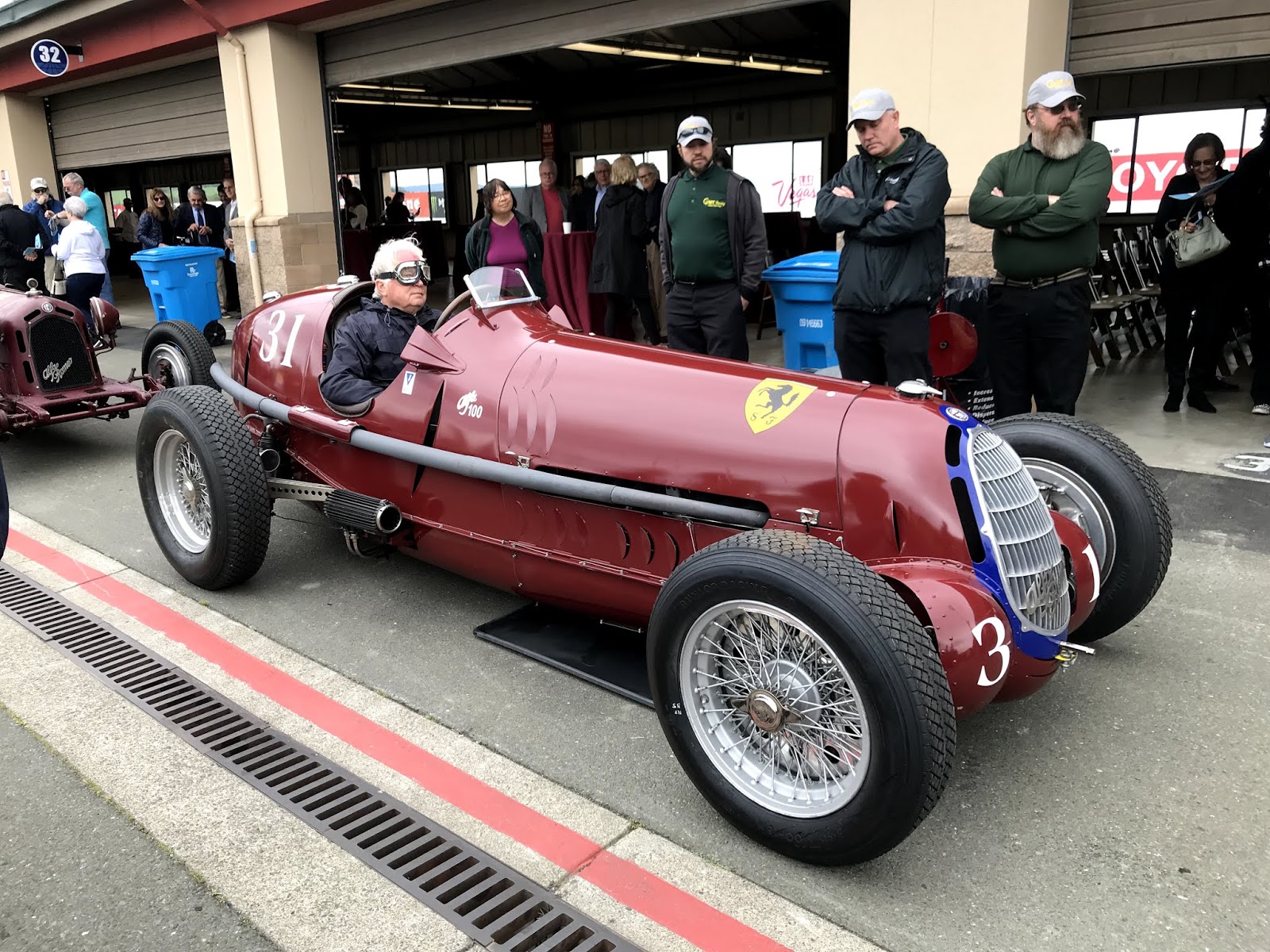
The first car is 1926 Delage 15-S-8, chassis #4 Louis Chiron 7th 1929 Indianapolis 500 1930 and 1931 Grand Prix car (Peter Giddings)


1932 Alfa Romeo Monza…Scuderai Ferrari team car (Peter Giddings)

 1935 Tipo C 8C-35 Scuderia Ferrari #65(Peter Giddings)


1947 Alfa Romeo Tipo 158D “Alfetta” re-creation(Peter Giddings)
Note that many of Peter's cars bear the number 31...his age when he moved to the US

1963 Ferrari 250 GTO
Scuderia Ferrari Alfa Romeo
David Love Vintage Races and Another Baby Blue MGB

Adin has become a very accomplished and talented driver. When we first got our MGB we were “blinded by the light” and did not do adequate due diligence. The car was not as represented and we learned, over a period of months, that it was really a pretty poor example. Despite that Adin managed to go from 15thon the grid to 5thwith a very sick motor at a season ender at Thunderhill the first year we owned it. 

With a new engine and much work by him over this past winter he was turning under 2:12 on the 2 ½ mile 12 turn Sears Point track when something failed in the shift linkage, either locking the car in gear or making it impossible to select a gear...one of those intermittent gremlins that can drive you crazy trying to diagnose. Of course we expected and were dealing with the normal teething pains that almost always accompany major changes to a race car...the main one being tire rubbing against a rear fender, before this apparent linkage failure. As it is impossible to gain access to the inspection cover on the side of the transmission with the unit in the car, it means the entire engine and transmission will have to be pulled before we can figure out what is wrong...thus ending any further opportunity for the weekend.

Adin was, understandably, quite depressed by this. Due to some problems caused by other cars he had already had his first track session cut down to a single lap or so, and came in after only a couple in the second session to assess the tire rubbing, which was when the car locked itself out of gear and ended the testing and racing for our baby blue roadster.

The Adair family joined the vintage racing community in 2008. I never asked them what made them get involved, but they have in a fairly big way. The parents, Dennis and Susan, are in their late 70s now and were pharmacists, while their son Kevin is an orthodontist. The first car I think they bought was an Elva Mk I, but they rapidly built up a fairly large collection, including an historic Austin Healey six cylinder car, a Lotus Elite, a Cisitalia (though I don't know which model) and a Moretti coupe. I have not seen any of the latter three, but they added another very historic and interesting car a couple of years ago...a baby blue MGB racer with a bolt-on hardtop.
Some of the Adairs' "Stable" from Conceptcarz
Elva Mki, historic Austin Healey, and the "Bahama Blue" Sebring MGB

The MGB debuted in 1962 as a replacement for the earlier A model, which in turn succeeded the first post-war European sports cars seen in the US, the famous “T” series cars beginning with the TC, then moving through the TD and TF from 1947 to 1955 
1949 MGTC
Note the 19" wheels
Barrett Jackson Photo

As with all cars, the first few can be considered “prototypes” in one manner or another. For example, Hollywood Sports Cars secured one of the first two or three serial numbered cars, which in turn became the first B model to win a race. Within the first five cars, three were built specifically to race at Sebring. One of these three has never been found, but two were located and restored to their Sebring configurations by Butch Gilbert many years ago. One of these eventually found its way to the Adairs . 

Two MGBs were entered in the 1963 race, but both cars failed to finish, suffering bearing failures. So for 1964 the factory approached Kjell Qvale ( Shell Kuh-valay) in San Francisco, as he had been successful at Sebring, finishing 7thoverall the previous year with a lightweight Jaguar E-Type. Kavle received three stock B platforms along with lightweight body panels stamped in aluminum from the production car dies, and a “high performance” motor, which was immediately rebuilt by Joe Huffaker (https://www.sportscarmarket.com/profile/1962-mgb-sebring-lightweight). Though one of the cars was out after only 15 laps due to an accident, the other two did quite well, although the #48 car bought by the Adairs was not quite as successful as the #47 car driven by Ed Leslie and Jack Dalton. It finished 17thoverall and 3rdin class, while the #48 car finished 22ndand 4threspectively. As the Adairs track board shows, #48 went on to race in SCCA for a decade before disappearing until Butch found it. Note that in contemporary or current pictures of the car Merle Brennan's name is not on the car, even though the Sportscarmarket artivle by Thor Thorsen and records of the race show him as a third driver. I don't know why he is not included on the car. Perhaps he only drove a short shift, but that is speculative. 
Period and contemporary photos of #48
Brennan's name not on car


On Saturday Dennis spun the Adair Elva in turn 11 and though there was no damage to the car he did “kiss” the tire barrier on the outside of the turn. Then in a later session he spun at the same place again, this time hitting the exit wall and damaging his car and also apparently causing another competitor to hit the wall and damage his car. The result was Dennis was banned from further driving for the weekend, leaving Kevin to drive the Austin Healey with no one to campaign the MG.

The Adairs (and likely a lot of other people at the track) were aware of Adin's competence as a driver, as well as how much knowledge about the MGB he has accumulated as he educated himself regarding the model and its racing potential. Still, it was a surprise to both him and me when he was offered the Sebring car to drive Sunday to replace our own ailing vehicle. The Sebring car is very likely the highest priced MG ever sold, at $180,000, and of course is a rare and historic racer, being one of only ten such cars with a factory “works” pedigree. But then, Adin has also successfully raced the Siata, which is valued at twice that amount and has an even more extensive history.

We used the Sunday short “warmup” for Adin to familiarize himself with the car. It runs on wire wheel rather than the bolt-on alloys Adin put on our car over the winter-no small task, by the way, requiring replacement of the carrying hubs and drums-and at this point my son is much more conversant about the car and model than I am. The Sebring car is also softly sprung and was set up to run reliably for twelve hours on a 5.2 mile virtually flat airport course rather than the 2 ½ hilly miles of short sprint racing we do at Sears Point. But adin adapted very quickly and was comfortable as the pilot with the handling, shifting, and power. His only concern was braking, as the soft suspension resulted in a lot of front end “dive” and rear end “wiggle” under hard deceleration, though he said it was still easily controlled.

He started last in the actual race Sunday afternoon, which was not a surprise to the other drivers as they were expecting the pilot to be Dennis. But by the end of the race he had caught and passed at least seven or eight cars, with lap times in traffic of under 2:09 or about a 70 MPH average. I'm sure his racing colleagues were wondering either who was in the car or what Dennis had eaten for breakfast that morning!
At tha back of the grid...but not for long!

A number of people congratulated me on my “coaching” and teaching of Adin, but as I explained, except for learning by watching, as he has done almost from birth, I had little to do with his skill and success. He is like a singer with “perfect pitch,” a “natural” behind the wheel. 

Still, I am quite proud of him and was flattered when, some time ago, he told me that everything he knew about working on or racing cars, he picked up from observing me. 
Adin waiting to staart warmup session


Monday, March 18, 2019

The Days Following A Race Weekend

The Days Following A Race Weekend

There is a mellowness associated with the days following a race weekend, where everything has gone well, which is difficult to explain but which is one of the most satisfying feelings I have ever experienced. It is beyond just gratifying exhaustion about a job well done. It is beyond joy and actually seems a very quiet type of ecstasy wherein the world seems suffused with softness and gentle light.

Driving near your own limits and that of your tiny jewel of a car, a hand built tribute to talent, beauty, and passion, requires such intensity of focus, concentration, and sheer mental and physical will that, when it is over, you have literally nothing left to give. It is beyond the fall off an adrenaline rush, which is often experienced as a physical crash. It is beyond the more subtle aspects of a drug high. It is, simply put, beyond anything else I have ever felt.
Leading, but not for long
Everything behind me has a bigger motor and more power

After every nerve, every sense, every fiber of awareness has been stretched and tested for turn after high speed turn, lap after lap, session after session, you look back and realize just how intense it really was, and how alive it made you feel. Not terrified and, not after 35 or more years of doing it, even scared or, once the wheels start the car moving off the pre-grid, nervous, but still so alert and attuned to every input of your own car and of those around you, you think again about just how much sensory input you had to assess micro-second by micro-second...a thousand decisions made so fast that it was your brain and nervous system acting almost autonomously, with very little time to consciously think through what was happening and what you needed to do.

Just consider...where are the flag stations and what are the flaggers doing? What is the track surface like? What is on it-oil? Water? Sand? Gravel? What do I need to do to set up safely and quickly for this next turn? Where am I going to come out of it and who is coming up on me from behind? What do I want or need to do about them to be safe and not impede my own progress? What is that cloud of dust up ahead telling me? Did someone go off? Where are they and what is happening? Is this car in front of me going into turn 3 too fast? Is his back end coming around? Will he collect it without spitting himself across the track in front of me and into the wall? Will he pirouette backwards across the track in front of me if he can't collect it? Where will it be safe to go in that event? Why did my car's back end not only start to come out, as it always does, but actually wiggled on that turn? Is that oil that that Maserati is spitting all over my windscreen? It smells like he is burning it. I need to watch for a slick trail going into turn 4 with the sun on it. Aha! There it is! Stay out of it!

This and a thousand other details. Is the car “happy?” How does the engine sound? I need to go back to double clutching on upshifts as if I don't the gears don't mesh smoothly. Is there a cough going through 5000 RPM? Did I imagine that? How does the exhaust sound? Are the tires gripping still (given that they are barely wider than bicycle tires in the first place and are street radials and the only ones which fit the car)?

It never seems like much to explain to people that I am only on the track four times a weekend, for a total of about an hour track time and perhaps 70 miles total, and at a track like Laguna the highest speed I touch, perhaps in three or four places per lap, is just under 100MPH.

“Big deal!” they might think. But look at the map of that track or any other and think about the 12 numbered turns, seven of which are 90 degrees or less, and all but one of which are third or fourth gear high speed thrillers, and all of which are taken at speeds for exceeding anything that which anyone with a brain would try on a similar public road.
Then add in some pretty severe elevation changes and some segments which will try and throw you off the track if you go too wide. Finally, dump in a sharp left/right complex (The famous Corkscrew) which has the steepest drop in the shortest distance of any track in the world-like falling off a five story building...blindfolded! Brake and shift 11 or so times a lap... in a little over 2 ¼ minutes, times eight or nine laps a session. Some 90 applications of each, four times a weekend, with all that attention riveting information pouring at you constantly. Except for aerial combat I can't think of anything as intensive. Maybe professional ice hockey? At any rate it is a truly unique experience, and one which is immensely satisfying when it goes right.

But it is addictive....a disease for which there is no known cure. Or as Peter Egan once said “Racing makes an addiction to heroin seem like a vague thirst for something salty.” 

Friday, March 8, 2019

Gil Nickel

Gil Nickel

I suspect most people knew Gil through his ownership of Far Niente Winery in the Napa Valley. Perhaps a sub-segment of that crowd was also aware of his participation and success in vintage racing. Even fewer, myself included, might have been aware that he was an avid motorcyclist. I only learned of that this year by reading one of Peter Egan's motorcycle magazine columns, gathered together in a book called “Leanings 3.”

But I knew Gil first of all through the old Bay Area Region of the Ferrari Owners Club. So what else is new? By far most of the people I know (or, in some sad cases, knew) in the world of toy cars was through my membership in that group. Those I did not meet there, even after joining the vintage racing brother (and in a few unfortunately all too rare cases “sister”) hood and adding to the population of driving obsessed nuts of all types, I was nonetheless bound to like some sort of rare earth magnet attraction to a steel bar, through various car clubs or introductions, by friends who knew of my “addiction” and took every opportunity to link me to others bitten by a similar insanity.

When I met Gil he was new to the Napa wine business and was turning the abandoned property he and his brother bought into what quickly became a beautiful and award winning winery. I learned the family was from Oklahoma and was in the plant nursery business...the jungle drums of the FOC said they had made their fortune landscaping freeways in Texas. At any rate, he had two interesting Ferraris at the time. One was a poster car for a peninsula Ferrari shop called “Cavallino Rampante,' a black Lampredi engined Superfast if my memory has not totally failed. The other was a similarly “odd” beast, a yellow 340 roadster. If anything an even more rare car than the black beauty.

Gil was the classic soft-spoken template for the part of America he came from, with sandy blonde hair and a round kind of cherubic face and broad, open smile. While the winery bucked the Napa trend of open tasting rooms and could only be visited by invitation, Sherri and I were there a number of times for FOC gatherings. As one would expect, given his background, it was beautifully laid out and landscaped.

The winery and residence were old, stone buildings with warm wooden interiors. Outside Gil and his brother had cut off the top of a hill and put in a sunken entertainment pit large enough to easilly hold a hundred or more guests. It was shaded by a large gazebo and bordering the pit were benches, counters, and cooking facilities. Of course there was plenty of wine as well. Far Niente quickly built a reputation based on an award winning chardonnay sold under what was said to be the most complex label in the wine business. Later an even pricier cabernet was added to the offerings. Though by today's standards in the US these don't sound overly costly, $40 and $100 repectively in the mid 1970s for California wines definitely “pushed the envelope.”

Then, like many of us in the FOC, Gil discovered vintage racing. Gil obviously had more money than I did, and when he jumped in (slightly after I made that plunge) he went in with nothing spared. I was still putting the Siata together I guess, and was parked in front of the old Frey Racing store in Santa Clara, contemplating how such small purchases, barely filling a single shopping bag, could have possibly sucked up so much money, when Gil came out with his arms full of goodies...driver gear as best I recall. Even then he had a box truck with “Gil Nickel Racing,” featuring a yellow curved road on a black background, lettered on it. Later there was a much bigger 53 foot trailer and tractor rig...as I said, he fell for the sport in a huge way.

Gil fell hard for Lotus race machinery...he obviously liked yellow as his Lotus 11, 26R, and 27 all were painted about the same color as the 340 Ferrari. Gil had a lot of other cars but, oddly, I never saw the barn with the full collection, though I was aware there was much else there besides the Ferraris and the race cars. I once drove a 4.2 E-Type Jaguar coupe of John Lewis's, which Gil later bought, for example.

Gil became wildly successful in racing, becoming European Vintage Racing Champion at one point...long before the US got involved in such foolishness as “vintage championships.” But it took the article in “Leanings 3” for me to learn he was an avid motorcyclist.

I wish I had known. We could have swapped even more lies than we did about racing. Gil died of malignant melanoma at the relatively young age of 64. His wife Beth continues to run Far Niente to this day. You can read a bit about him and the place here:http://travelcuriousoften.com/curious-thirsty/far-niente-a-vintage-love-story/.