Saturday, July 14, 2018

Ashes In The Handlebars

Ashes In The Handlebars

I'm not sure why I still have it, sitting in the shop. Surely it is unlikely I will ever restore it, and yet I have never really considered scrapping it, despite Sherri's oft-repeated request that I do so.

I speak, of course, of my 1977 Suzuki GS750, fifth and next to last (well, maybe) motorcycle.

Oh, I did mention that my automotive history included six motorcycles, didn't I? I'm sure I mentioned that my first non-human powered transport was a Moped. After that I graduated to a Cushman Eagle.In fact, I rode for some months before I ever drove a car. But I don't include those basic transport modes in the six.
It seems more cool now than it did then
©Mecum Auctions

The odd car gig happened like this. Some friend, long since forgotten, had a buddy who was 18 and had his full-fledged license. Best I recall I was 14 and had only recently received my learner's permit. This allowed me to ride a “motor driven cycle” of five or less horsepower, and to drive a car “under adult supervision,” meaning...an 18 year old would work just fine! As I write both those statements I am astounded at how uncomplicated the world was, and how there seemed to be little risk in either activity, despite the fact that a young person like me at the time had absolutely no prior instruction in either riding or driving!

I believe the car I thus had my first experience behind the wheel with was an early 60s vintage Falcon...with stick shift no less! When I told Dad about my first lesson in the car his response was “good, you can tear up someone else's car rather than ours.” 
Not cool back then
But I didn't care
It was WHEELS!
And someone else's gas money

Good ole' Dad. Such a confidence builder.

To me, the moped and Cushman were somewhat embarrassing conveyances, with their only redeeming features being that they were (barely) better than walking. The moped was so underpowered I could actually pedal the thing almost as fast as it went under power. The Cushman was better, but the centrifugal clutch was so slow to “hook up” it was a real dog off the line. 

So as soon as I got my “full” license at 16 I was off two wheels and into four with the Dodge Dad bought pretty much for my exclusive use (Uncool? Yeah, But I'm Riding and You're Walking!).

But after “tasting” the amazing “grunt” of my roommates Suzuki X6 250 when, at the time, I was driving an Austin Healey Sprite with a 0-60 time you needed a calendar to compute, I was again intrigued by what, in particular, a two-stroke bike offered in low cost thrills.

I had to have one. And even though both Mom and Dad were totally opposed, Mom actually loaned (gave?) me the money to buy my first bike...a used Yamaha “Big Bear” 305.
Definitely Cool
Classic good looks
Brakes and Frame too
Yikes!
While not as quick off the line as the X6, in similar fashion the engine power was far ahead of either the suspension or brake's ability to handle...while I have always been a conservative rider I was quite willing to use that power on occasion. It was exhilarating....and probably a lot more dangerous than I thought.

When Marcia and I got married I thought it was time to “grow up,” and sold the bike. I spent the next six months sniffing the exhaust of every motorcycle I got near, and was miserable. I finally scraped together enough cash to buy a used Honda 160, which made me even more miserable.

This was my firsst four-stroke bike, and while well built, I was amazed at how far behind in terms of fun quotient Honda seemed to be. Their “big” machine was a 305. It was top heavy and, relative to either the Yammie 305 or the Suzy 250, painfully slow. The 160 was the worst of both worlds. Built as a “Scrambler” it was also top heavy and even slower than the aforementioned “Dream.” I might have dubbed it the “Nightmare.” I actually tried to use it off-road once...a true disaster. But then, a high pipe Yamaha 305 was available, and no doubt would have been even worse.

When we moved to Georgia for me to continue Grad School I had had enough of the Honda, and almost as soon as we arrived in town bought my own X6 ( see WTF...or HRD?  for my own introduction to the X6). I had to go to Atlanta to get the bike, and of course return there for its first, break in service. It was 31 degrees when we left Athens for the 60 mile ride to the shop, and 29 when we got there. I don't believe I had any protection other than a helmet and a jacket, and we were both totally exhausted and hypothermic when we arrived. My hands were so stiff that the right one had taken on the curve of the throttle, and I feared the shape might be permanent.

But we survived the trip, and I kept the bike when we returned to Florida. I remember that at one point we were living in the back unit of a one story duplex in Miami Shores. I kept the bike on the sidewalk leading to the unit, and there was an identical, though mirror image, unit opposite, on the sidewalk of which was a Norton 850 Commander This was the killer British machine to have at the time.
THE Bike of the early 70s
Wikipedia Photo

Thing was that, like all Brit bikes of the era, reliability was not its strongest point. My Suzuki had electric start with a kickstarter for backup. The Norton was kick only. While Miami was rarely cold, it could get pretty cool in the winter, while still maintaining relatively high humidity. In these conditions the Norton could be quite stubborn about starting. I would try hard not to gloat when I pushed the button on the Suzy and the “world's fastest popcorn popper” instantly came to life, albeit sounding like a wounded house cat. As I left for work the Norton's owner was still exhausting himself cranking his monster.

By the time I decided to trade the Suzy (why, oh why?) Honda had come out with their first really big bike, the 400 twin, and Kawasaki had blasted away the “fastest bike” title with their 500cc H1 two-stroke triple, which quickly became nicknamed the “Widowmaker.” The power of this thing was so far beyond the ability of its frame to stand the flex, or its brakes to shut it down, that it was, and remains, one of the most dangerous street machines ever produced. 

Of course we all lusted after it. When the company decided to produce a supposedly somewhat tamed little brother of 350cc I was all in for that. 

Worst bike I ever owned. Within six months the paint was fading and every rubber piece on it was falling apart. But that wasn't the worst part. While undoubtedly quick, it did not feel faster, nor was it, than my X6 and, unlike that well balanced machine, wanted to become the “world's fastest unicycle” if you did try to wick on the throttle. The front wheel would instantly try to point at the tops of the telephone poles. Pure evil. 

And the gas mileage, or more precisely, the lack thereof, was amazing. I calculated it multiple times before I would believe that 350cc could really get only 22mpg. That, of course, was well after the beast dumped me by the side of the Florida Turnpike one day. I had switched to to the reserve setting all bikes had back then when it began to stutter...and ran totally dry about five miles further on. I just couldn't believe it.

The night it was stolen off my driveway I actually felt relief. This was enhanced greatly when I got the insurance check, which was just big enough to pay cash for a used Suzuki 305.
Another Good Looking Suzy
And another Mecum Photo
 Do you detect a note of brand loyalty here? I always liked the company and thought their products well designed, good looking, and exceptionally well behaved and quick. 
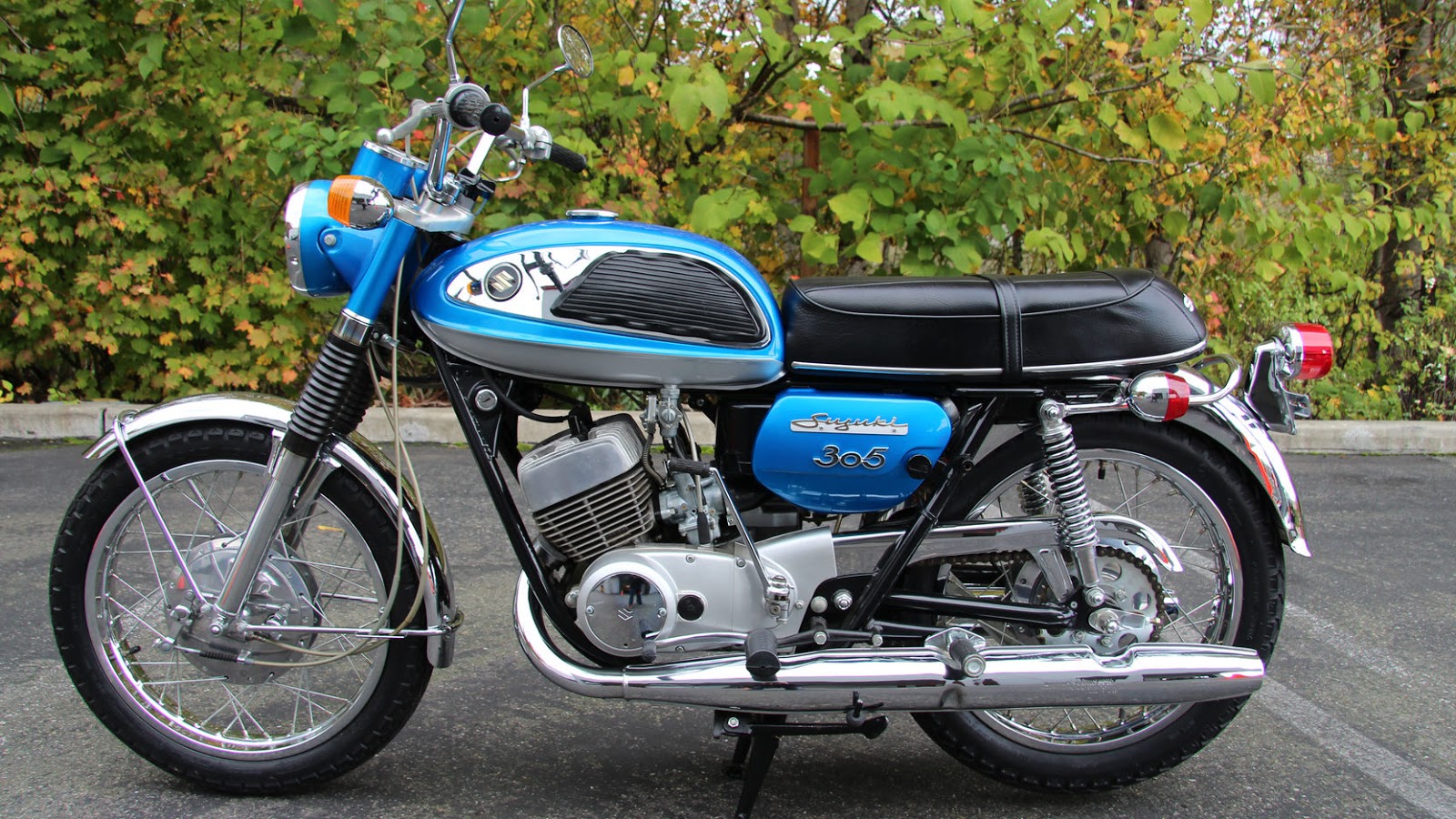
This was the bike that moved with me, buried in a U-Haul trailer connected to a 24 foot rental truck, to Las Vegas at the end of 1972. In early 73 I took a ride outside of town, on US 95. I stopped for a break near the junction with NV156, one of the routes up Mt. Charleston. I took one look around at the totally empty vista and realized...we're gonna need a bigger bike!

Enter yet another Suzuki, the 550 triple. The firm also made a larger 750 version, but after the 305 I figured the 550 was big enough. I outfitted it with a small fairing, and wandered all over the desert with it for the two years we lived in Vegas. 
My 550
In Front of Our Home in Redwood City
c1975

I kept that bike for another couple of years after we moved to California. It was big enough and fast enough to stay with anything, and I remember in particular our first real exposure to Bay Area weather. We were living in San Mateo at the time, so this must have been the summer of 1974. When we left that town the temperature was about 75...pretty warm for that part of the Bay. We were headed for the top of Mt. Tamalpais in Marin County, where we planned to picnic overlooking the City and the Bay. 

We were astounded when we reached the Golden Gate...it was in the 50s and foggy...we were freezing! Then we zipped up through the Waldo tunnel and on into Marin. When we reached the top of Mt. Tam it was 96 and sunny. In about 30 miles the temperature had first dropped 20+ degrees in about 25 miles, and then climbed over 30 from there in less then ten. Welcome to California!

Two-stroke bikes are simple, and should be durable. But motorcycle technology in the early 70s was progressing rapidly, mainly in suspension and chassis design as well as braking. By 1976 Suzuki hit the market with their first four stroke, and it was a winner right out of the box. 

I first noted the GS750 in Through the Corkscrew II. I did not rush out and grab the early 1976 model, but by 1977 I was convinced it was the way to go next in my progression with bikes. In particular, it had front and rear disc brakes, a huge improvement over any drum system. It was also absolutely gorgeous, and I was convinced that the company would not put a bike on the market which did not meet their usual high quality standards.

Still a good looking bike
And a great ride
Beautiful Handling and Plenty of Power (60hp)

I was right. So in early Spring 1977 I bought the bike which now sits in disarray in my shop. Not that I didn't get my use out of it. By the time I stopped riding regularly, in about 1984, I had put 40,000 fun miles on it. It was still in fine shape and totally reliable. Though it also was the only bike I have ever dropped, and I did it twice. The first time was much more dramatic than the second, though I'm not sure Sherri would agree.

I was taking my usual route to work...which meant peeling off 101 onto 280 near Army Street, then off at Mariposa, across the China Basin Bridge, and on to park someplace like Montgomery Street. In the early days there were no motorcycle parking spaces, so I often left the bike in an unobtrusive place on the sidewalk. Most, but not all, meter maids would leave me alone, since by doing that I was not tying up a space for a car. When the City first put in bike parking spaces I recall a few of us standing around and looking at them in amazement. Wow...something sensible...in San Francisco!

Fortunately, when I dropped the bike I was in full leathers, with gloves and boots. And it wasn't the bridge grating which got me. Though that is scary as your machine wobbles about it is not really dangerous and there is little chance the grid will actually drop you. But leading up to and across the bridge is a railroad siding which runs through the right lane of the street, and that is dangerous. Both on the street and on the bridge you do not want your wheels anywhere near those tracks.

I knew the siding was there...I rode this street every day. I knew I needed to avoid it. What I did not know was exactly where it started. And that was further hidden by a delivery truck in the right lane. As I started to cut to the left to pass the truck I started the move just as I came to the siding. My front wheel cleared the track towards the left lane just fine, but the back crossed the lefthand rail at a shallow angle, tried to play trains, and came around sideways.

I suddenly found myself on my hands and knees doing 40mph without a bike. Fortunately I came off the back and did not “high side” it. I was just fine and the bike sustained only a couple of scrapes to things like the clutch lever. So after 15 years of riding, the mantra about there being only two types of riders caught up with me...either you have been down....or you will go down sometime.

The second time was just...annoying. I was in the left turn lane of El Camino Real southbound at Whipple Avenue, going to turn and cross the Caltrain tracks. When the light changed I slowly started forward, and the back wheel started to try and pass the front of the bike. I backed off the throttle, but the wheel continued to swing out, gradually assuming an unrecoverable angle, and down we went.

Yes, Sherri was on the back...the last time she rode. There was no damage to either of us or the bike, and I was confounded about what happened. There was nothing visible on the pavement to explain it. I could only conclude that, while I knew about so-called invisible “black ice,” I had just stumbled into “black oil,” an invisible film with just enough slickness to cause a traction loss of my back wheel.

Still, not bad for over 25 years on bikes.

But by 1984 I had not only stumbled my way back into sports cars in a big way ( see Through the Corkscrew II), I was also half way through turning a “roller” and nine boxes of parts into a vintage race car (I Think I'm Alone Now; There Doesn't Seem to be Anyone Around).

I also realized two things:
  • The Suzuki needed work
  • I was really just riding it to work and back
The work included a leaking front shock and a rear sprocket which was pretty far gone...to the point it might be unwise to ride the bike without replacing it. As for riding to work...in the ten years since we had moved to the Bay things on the roads were already getting a lot more dicey. From “laid back and friendly” there was a new aggressiveness and tension which grew out of the development exploding from the former groves of the Santa Clara Valley, which had been newly redubbed “Silicon Valley.” It was getting dangerous to ride a bike up 101 every day. And I was already anticipating a new hobby which was also life-threatening. I decided two such activities with a wife and young child might be tempting fate a bit too far.

So I parked the Suzy in a shed I built next to the garage, totally planning to “get back to it” one day. Hah...life had other plans. 15 years later I cut dozens of vines away from it, undid the frozen rear caliper, and hauled it out into the daylight to bring it up to Jackson.

It was a mess...corroded chrome, peeling paint. Sad indeed. I parked it in the shop, out of the way, where it has sat ever since. 

I did have one more bike, a Kawasaki 150cc “metric cruiser” or “wannabe Harley” if you prefer.
My Wannabe Harley
I never grew to love it
 A group of guys up here wanted to ride, and those were the kind of bikes they wanted. While I could have bought something that I likely would have loved more, I fell in with what the group had, a big though relatively nimble machine with footboards and loads of torque but neither the looks nor the ride of the Suzuki. 

And then the guys started feuding with each other, and I realized that, with leathers and some body armor for protection, it was too hot for me in the summer, and too cold in the winter, to be comfortable. I found myself saying “I need to ride the bike” instead of “I really want to ride.” I sold it in 2004 and used the proceeds to buy the closed trailer I needed to take the Siata cross country to race. (See the “Long and Winding Road” series). 


Wait...”where it has sat ever since.” Isn't that the same thing that happened to the 914 (see the “Bring 'Em Back Alive” series)? And look how that came out! Assuming parts are available it would not take much to put the Suzy back together...

And that would resolve Sherri's concern about this visual reminder of the effort it will take to clean up things if I die before her. In fact, as the title of this piece attests, she has threatened multiple times to have me cremated and my ashes stuffed in the handlebars of the bike if I do not get rid of it. 

While I actually think that is not a bad place to wind up, I am reminded of the (paraphrased) words of Road and Track's Peter Egan as a cautionary tale: “Stop Me Before I Restore This (Bike)”

“Then one night over cigars and too much brandy, I began to take the thing apart.”

Bulletin...a couple of weeks later
I happened to mention this article to Sherri, telling her it was triggered by realizing how good a title her "ashes in the handlebar" threat made. I then mused about the last lines of the piece, about how it would not seem to be a difficcult project to get the bike back on the road.

She not only said "hey, why don't you do that with your grandson" (who is already riding his own bike...a Ducati 750), but she then texted him asking him if thar would interest him.

The Internet being the greateest tool in history to test how practical exercises like this might be, with no effort at all to find out, I meantime "Googled" "Suzuki GS750 parts" and had enough hits which seemed to have, in a quick glance, extensive lists of brake, cable, engine, body, graphics, and other parts to make further investigation worthwhile.

Tristan, of course, said he would love to do that project. But, Tristan being Tristan, interest does not always translate into action. I would be willing to give him the bike at the  completion of the activity if he at all would stick with putting any reasonable (tbd) effort into it.

Wait, I probably should not be putting that in print!

Uh oh...have I just taken on another restoration project?


Saturday, May 19, 2018

Dino 206SP

Dino 206SP

Enzo Ferrari had only one child within his marriage...Alfredino “Dino” Ferrari. Named after his grandfather, the founder of the first metal working shop which was also Enzo's boyhood home and which recently opened as a Ferrari museum in Modena.


t

Though Ferrari built at least one motor of 2, 4, 6, 8, and 12 cylinders, by the early 1950s the iconic engine for cars bearing his name were Colombo designed V12s. The inline six was an experiment which, as far as I know, was only used in the 121LM, a rather awkward design said to be beastly to drive and impossible to tame.
121LM
Looks almost good in this shot
Despite odd hood lump
and tiny grill opening
Tail fin from headrest not obvious
 Dino was a proponent of the V6...in that he prognosticated the future, as this has become the standard for 21stcentury performance road cars.

I think though, that while the old man was willing to try the configuration for formula racing, he was afraid that a road car with less than 12 cylinders badged as a Ferrari would not sell. Thus the fendered racers as well as the first street variants bearing V6 motors, up through the 246 series and ending with the 308GT4 and early 308GTB, also badged this way...these cars all bore badges with the son's signature of his nickname in script on a Modena yellow background.

In an era which ended in the early 70s, the three great auto races run on open roads were the Tour de France, the Mille Miglia, and the Targo Florio. By 1958 the only one left was the Targa, the oldest of the three. The course was brutal...mile mile of broken pavement on the poorly maintained roads of Sicily. It was no place for the faster and bigger cars, as the roughness of the pavement, the tightness of the turns, and the closeness of many of the buildings, all made it likely that the bigger, faster cars would wind up in the weeds...or worse. 

It was a natural for Porsche, but Ferrari could not ignore the challenge of such an event on what was, though world apart from the rest of Italy, still part of his “home turf.” Thus was born the series of Dino racers such as the 196 and 206 specials...the “S” and “SP” prototypes built with the Targa in mind. So Bill Schworer bought and restored one.
Maybe Bill was looking for another two liters?
Number as used in the 66 Targa Florio

 Like most of the rest of us in the Bay Area region of the Ferrari Owners Club, Bill was moving into the then new sport of vintage racing. Unlike most of the rest of us he was in one of the “up” iterations of his “boom or bust” financial life. He was an ambitious home builder, which even in California can be a roller coaster ride, not for the faint of heart. Oddly, I don't remember a single one of his street Ferraris, but I didn't need to dig out old photos to remember a lot of details about my romance with the 206.

I also, however, remember in detail his wife's car.

Deanna Schworer was a very special lady. More than a few years Bill's junior, I thought of her as a mysterious and mystical spirit. She always seemed to me to be sitting quietly in the background somewhere, and I always picture her at the spinning wheel which sat in her living room...I had never before nor since seen anyone spin their own yard...or knitting something with the thread she had created.

Among other projects, Bill had been the developer for Meriners Island, a community of townhouses off the San Mateo bridge stuffed into a bit of land between San Mateo and Foster City. Somehow he had found room to also build his own home there...one of the most intriguing places I can ever remember. 

First of all, it had a single bedroom, but included a two car garage, which Bill had made a showpiece, complete with terra cotta tiled floor...a touch I never saw anywhere else, and I have seen some pretty fancy garages.

I remember that the living room included high, clerestory type windows, complete with stained glass. In fact, the feel of the room was very much that of a small chapel, a place of quiet refuge.

Oh yeah, Deanna's car...it was a silver 330GTS convertible. From 1960 or so Ferrari had moved from the 3 liter 250 through the 275 and on to the 4 liter generation of Colombo-designed V12s. I have always felt the 330 comes across best in the more popular coupe version, and the market I guess agreed, as I believe the S was rare even by other convertible versions. I still prefer the 275 pictured in another post, and never thought John Lewis's yellow bird lacked “giddyup.” But the 330 was definitely fast, and Deanna was no lightweight in using everything it had.
Pretty in Yellow
From ultimatecarpage.com
But I still prefer John's 275

I remember in particular at least one occasion where she displayed that verve convincingly...twice on the same club outing. 

We had a group of perhaps five or six couples and cars who went for a weekend to Hearst Castle at San Simeon on the California coast. As anyone who had driven the Coast Highway can attest, opportunities for enthusiastic driving on most of this road are few and far between, and it is entirely possible to get stuck behind Grandpa in a 40 foot motorhome and lump along for miles at about 25 MPH. But shortly before you come to the castle there is actually a short four lane stretch where there is no risk of going off a cliff if you happen to lose it, and the curves are more gentle than on the rest of the road.

I seem to recall at least the following cars there...Bill and Deanna in the 330, with her piloting, The Jones's in their yellow 246GTS Dino, The Thinnesen's in their red variant, Sherri and me in the 2+2, and the Morton's in their 330GTB. Deanna hit that four lane and just...disappeared. We all put our feet in the carbs, and I remember hitting well above 200kph on the speedo, and none of us got anywhere near her!

On the return trip we were better prepared for her...enthusiasm. The Schworer's had invited us to their place at the end of the weekend for wine and snacks. The lsat part of the route was up I280 on the hills above the main SF peninsula population areas. Once more Deanna “put her foot in it,” and once more, in those beautiful and, in those days, empty hills on one of America's most attractive freeways, we were all dancing along at triple digit speeds all the way to CA92 and down to her Mariners Island home...where Deanna quietly sort of somehow seemed to just...sit back in a zen-state and assume that mysterious subdued yet so attuned state of being.

Oh yes...the 206. When the restoration was finished Bill had what I can only describe as an unveiling. Pretty much the usual suspects were invited to see the car, displayed attractively on that startling tile floor. It was just gorgeous, and a very historically significant little beast. Also on display was a copy of the Road and Track cover photo of the car in flight at the 1966 Targa Florio, where it finished second. To top it off, while Bill Morton was pissed off that he could not fit his frame into the seat, nor his legs under the wheel, and had to sit with his head titled sideways even without a helmet, I slipped into the seat with plenty of room to spare.
Helping Bill get belted in
Gee Sher, I fit it better than him
Can't I have one?

Sherri immediately recognized a certain glint in my eye and shook her finger at me. She needn't have bothered. Neither then nor now could I have afforded as much as a down payment on the sales tax for the car, no less the full price.

As it developed, Bill was frustrated with the car and later sold it. While the car was perfect for the Sicilian event, the nature of vintage race grids was that it was always in with bigger and faster FIA championship variety cars, where it usually ran dead last. Even Laguna Seca is not “twisty” enough for the car's handling advantage to enable it to show well against a 250LM or Cobra Daytona.
I believe this is a 612 Can Am Car
At any rate, too big and fast for the 206

I could have cared less and would gladly have parted with dearly loved parts of my anatomy to own it. 

Deanna was not only a shockingly fast driver, she was an accomplished pilot. She and Bill had both been married previously, each having a child from that union...Deanna's son was a few years younger than Bill's daughter. 

The girl was a talented photographer as a teenager when we knew her. In fact, to this day a photo of hers of Adin, taken when he was perhaps five or six, sits on top of one of our floor speakers in the den-it is my favorite shot of him as a child.

At the age of 38 we lost Deanna...a staggering shock. We were all just a couple of years older than her. None of us had likely experienced death among our friends before. The sheer unexpectedness of it was disorienting.

Bill was at the races with his daughter. Deanna had rented a plane and flown up to Oregon with her son..I believe she was originally from that area of the country. She had offered to take some friends up in the plane to show them around from the air...it was a family of four and there was no room for her boy, for whom this type of sightseeing was, no doubt, “old hat” anyway. So he stayed behind on the field to wait for their return.

They never did. I can't imagine what it was like for him when he finally learned they were gone forever. Though at this point in my life I tend to think of almost all children as ten years old, I really do think that was about his age (his half-sister was about 16 at the time). What a horror for him, with no one around at the moment but strangers.

Deanna; wonderful, mystical, talented Deanna...had made a horrible amateur mistake. She had flown into a three sided canyon, a place where the only choice was to either climb out or turn around. And if neither was possible, there was only one outcome. What must it have been like for all of them to know what was coming. Or did the family know? Did she keep that from them and face the inevitable with the grace and quiet acceptance with which I think she was blessed? No way to know.

But what I do know was what happened when we gathered at the funeral home for the first “celebration of life” I had ever attended, a concept which was uncommon and “new” back then. We were all standing around on the corner in front of the building, still in shock and trying to work up our nerve to go in, when here came Bill. 

I don't remember his exact words, but the impact of what in general he said changed me forever.

“Why the long faces?” he began.
“Am I hurt? Of course. Am I angry at her for leaving me alone? Sure. Am I also angry that she made a stupid mistake? You bet. But we are not here to mourn Deanna. We are here to celebrate her life. She died doing...exactly...what...she...wanted to be doing. How many of us are going to get to say that?”

And in we went.

Somehow my memories of her and that 206 are wrapped up around each other. I smiled the other day when I ran across old photos of the car at Laguna, and that made me see her smile as clearly as if she were standing in front of me.

Sheer magic. She makes the one on that painting in the Louvre pale by comparison. Julia Roberts made a movie called “Mona Lisa Smile.” Julia is a beautiful woman and that big wonderful mouth and smile are charming, but there is little about it which is mysterious or mystical.

Deanna, on the other hand, truly had

The  Mona Lisa Smile

Sunday, May 13, 2018

1989 Monterey Historic

1989 Monterey Historics

Sherri has long expressed the desire to reduce clutter around the house. Like most people our age, we have accumulated quite a bit of “stuff,” adding to it year-by-year. People who move about regularly are forced to cull this “stash” at least somewhat each time they relocate, but we have been in this house for two decades and spent even more than that in our home in San Carlos, so the piles are quite extensive.

She has done a bit of work in other areas (and I have been totally AWOL in the activity so far), and a few days ago started to tackle our numerous boxes of photographic prints. It might be hard for millenials to understand in this digital age, but well into the early years of the new century, you took pictures with cameras on film, and had the negatives processed by companies which then gave them back to you along with prints of the frames on special photographic paper. In some cases they provided duplicates of each shot so you could “share” the photo by giving a print to someone else. Of course you could also provide the negative back to the processor to produce additional prints later.

At any rate, like many couples we had accumulated both albums we had made and boxes of prints...most of which then got relegated to a shelf in a closet and were never looked at again. So Sherri started “culling the herd” and gave me a stack of car related photos to go through and do the same.

We actually had reduced the stash of prints we reviewed by about 2/3...which was easy since many were simply poorly shot and others were just duplicates. But a couple of days later, as she continued the process, she gave me two regular envelopes to go through, on which I had written “1989 Monterey,” and which contained color photos I had done at that event.

Like much of my car photos, these were of cars which are unlikely to ever be seen again at a single location and in such great numbers. Many of the cars are now worth tens of millions of dollars each, and even for the “new” “Monterey Reunion” which succeeded the Steve Earle “Monterey Historic” races he created, this is heady stuff and a lot of these cars simply disappeared into collections dispersed all over the world. At least a couple, shown here, were special to me, as they were owned and raced by friends, many of them buddies I met through the old Ferrari Owners Club.
Looks like a "normal" 250 California, Right?
It's Decidedly Not
A very rare, all aluminum competition version
Mike Cotsworth aboard

The Cotsworth 250SWB Cabriolet (“California”) needs a bit of coverage. It's quite a story. Mike and his wife Vicki were at an early Montery event and were looking at a similar car parked in the paddock...a steel bodied road car. A gentleman wearing a hat like the one in the photo of Shelby below stopped and asked them if they liked the car. Who would say “no?”

“Well,” the stranger explained in a soft drawl, “I own one I would like to sell and you can come look at. It's parked under a tree on my property in Texas and needs to be rebuilt.”

Mike and Vicki actually took him up on the offer. The car looked pretty sad, and had been under that tree for years. It did not run, the interior was a mess, and the tree was a plum tree...the fruit had put purple stains all over the car.

Mike wanted nothing to do with it. It was Vicki who had the guts and imagination to see what it could become. They bought the car and, as they started into the restoration of it, found out exactly what they had and how rare and special it was. Even as early as this photo was taken it was worth over a million dollars, an almost unheard of figure in those days.
A Really Brutal Beast....
Despite the classy white walls

The “Carsten” Allard was owned, at the time of the photo, by my friend Dave Brodsky. Dave was not a racer...not even by vintage standards. I could regularly and easily pass him in his Edwards/Blume Crosley special. The Allard is a handful for anyone. This car is quite famous, winning race after race with Bill Pollack behind the wheel. It scared the bejesus out of Dave, and he later invited Pollack to drive it when Allard was the featured marque for the event. And yes, it did race with those white wall tires.

David Love and Mary Ho
One of the most well known Vintage Cars in the World
1958 250TR "Testa Rossa"
Now Owned by Tom Price
But it is the pictures of David Love's 250TR which need the most explaining. You see,
Price's "Other Car"
1963 250GTO
David was my first driving instructor when I decided to join other members of the FOC and go vintage racing. In fact, I spent the first few laps sitting where Mary Ho is in the full shot of the car. I was in awe. I was in heaven. I had no idea where the track went or what David was trying to tell me. I kept staring at the little brass plaque shown in the shot of the car's dashboard. It was from an old pinball machine and said simply...”Insert coin to begin game.”
Coin Slot at Far Right
David did have a sense of whimsy
I said nothing about it and stumbled into my own 2+2 to follow him around. I focused on the “stinger” ends of his tailpipes. They, like the windshield bracket (you did notice the windshield bracket, right?), were works of art, not car parts. Pure jewelery.
When we came in and he asked if I had learned anything I sighed “yeah, that car is just f*ing gorgeous.”

A couple of shots were of famous racers from the 50s and 60s...Sir Stirling Moss and Carroll Shelby in particular...it is shocking to me how young they looked in 1989.

Sir Stirling Moss
I think the lady is his wife
But I'm not sure
World's Shrewdest "Chicken Farmer"
Carroll Shelby
I wonder what he's holding?
But it was the series of photos at the end of this entry which not only brought back memories of that event, but gave me the same “hair on the arm rising” thrill it did when I first saw the display. Somewhere I have a photo as I first saw the display after just arriving for the race, and well before the track was opened to the public. In that shot it is wreathed in and surrounded by fog, and looks as ethereal and surreal as the real scene must have been back in 1959.

In the first 20 or so years of the Monterey Historics, no single sponsor owned the paddock displays. Thus there was not the commercial and unified approach implemented when Rolex became the owner of this area. At the same time, there was actually more creativity and diversity shown in these earlier showings, including, for example, such wonders as a reproduction of a section of a 1920s board track, on a significant slope, complete with a Miller race car strapped invisibly to the track and looking for all the world like it was in full flight.

The Aston Martin display was so authentic it included mannequin gendarmes and mechanics standing behind the cars, and faces of spectators in the stands, including famous figures like Marilyn Monroe, James Dean, and Elvis Presley. The cars were the ones which actually ran that race, which gave the company the world championship for sports cars. I believe the actual car was number 59, and the winner was driven by Salvadori and Shelby.

But even that was not the thing which impressed me the most about the set. At the time Ford was fairly active in the event, mainly through the efforts of a Ford official named Tom Senter. There was a breakfast they hosted in the old and intimate amphitheater area (since gone to build the new, and rather cold, media center), There was also an award for the best Ford powered car, as judged by Tom and later, after he lost a battle with cancer, by his wife and daughters.

At the time Ford owned Aston Martin. You would have expected that to be played up and plastered all over the place in a year when the brand was the featured marque for the race, and where the company had gone to some non-trivial expense to build that wonderful display. But you'd be wrong. There was nothing, and I do mean nothing,mentioning Ford or the link to A-M in that display, or anywhere else at the event. If you did not know that Ford owned Aston Martin, after you looked as closely as you wanted for as long as you wanted, nothing in that display would reveal that fact to you.

It was the classiest thing I had ever seen. It remains that to this day.

The Winning Car
Salvadori and Shelby
History in Motion


Saturday, May 12, 2018

Drake

Drake

I've put off writing about him since I began this blog...he is just too daunting a subject, and I've dreaded getting started. I've mentioned him in a number of posts, and I don't think I can put off at least starting to peel into the many layers of which he was made, any longer.
Ernie and Marylou
For Ernie this was "Dressing Up"
Must have been at some 50s party


Ernie Mendicki was born in 1938...his middle name was Drake. Obviously, kids being almost universally cruel at certain ages, they called him “Duck, duck, waddles.” You see, he had a serious heart condition, and was also, even as a child, large. He was unable to run and play the usual macho male child games, thus the cruelty.

So Ernie spent a lot of time alone as a child, and being both bright and gifted with superb eyesight and small motor coordination, started building models. The kits available in that era were small scale and lacked many of the amenities those of us building a decade later had, not the least being more than the most sketchy “instructions.” Yet Ernie produced beautifully executed finished cars, including finely painted interiors and engines. I inherited a few of these, and I take a lot of pleasure in examining them and marveling over how well they were done. I also got a few that, even with the volume he did over the years, he had not managed to assemble. I have not tried to do so...they simply intimidate me and I know I cannot achieve a quality with which I would be content to display on a shelf next to his work.

As a young adult and continuing through his life, Ernie began to modify kits or to build “from scratch,” particularly when he became a model railroader. Again, I have and treasure some of that work of his...a model J Dusenberg modified to be a duplicate of one owned by our mutual friend John Lewis, complete to the correct and perfectly painted and lettered license plates, and replicas of all the stations on the old Yosemite Valley Railroad, which was nearby to where he grew up, containing such details as perfectly level open tread outside stairways executed in 1:160 scale...where one foot equals a tiny .075 inches.

When I say Ernie was “large,” I should qualify that. As an adult he was over six feet tall, and likely weighed 275 or more. His hands were huge...one big paw could cover both of my admittedly small ones. And yet his dexterity and vision were nothing short of startling.

Ernie could read the license plate of a car coming down his street before I could determine the make. And despite his size, he could sidle through a store selling glasses stacked on shelves along very narrow aisles without the slightest disturbance of them. Me? I could create a snowstorm of shattered glass with twice as much space.

I'm dancing around him here, as it is intimidating for me to try to come to grips with the huge influence he was on my life. But it's time to start into that.

After that first burger flipping introduction to Ernie at the FOC picnic I've mentioned in another post...sometime in the mid to late 1970s...I don't recall seeing him much. While Ernie had been granted lifetime membership in the Ferrari club due to his knowledge, contacts, and the cars he had owned, he really was not a joiner, and though a founder of the SF chapter, he did not like the trend away from shade tree mechanics and towards ever fancier and more expensive events, so he stayed away.

I'm not a joiner either, but there was so much new to be learned and, as detailed elsewhere, the people were so warm, friendly, and welcoming that I spent a lot of weekends participating in various club outings. So, if not for Gary Winiger, I might not have connected further with Ernie, and my life with cars would have been much the poorer for it.

I need to devote much time to Gary, but though I really did not know him all that well at the time, he somehow discovered that Ernie and I were both railroad modelers and enthusiasts, and that we modeled in the same scale. Over the years I have more than once mused that Gary would have liked to build models but thought he did not have the requisite skills. He certainly always exhibited an interest. At some point he told me about Ernie's layout, which took up the second bedroom in his home (he was between marriages at that point I think, or maybe had just married Ann, his second wife).

I was working for Burroughs Computers in San Francisco, and it was someone who reported to me who was the catalyst for my own return to railroad modeling. John Hinkle and I were browsing through a bookstore on our lunch hour when I picked up one of those bargain table books every such store seems to have, particularly near Christmas. I mentioned to John that I had built several layouts and that I had equipment “in storage” and he urged me to buy the book. I did and was once again hooked, beginning one of what became several evolving schemes leading ultimately to the three level complex occupying its own special room in my workshop.

Ernie had let his layout languish for some time, but once Gary “put us together” it rekindled his interest and before either of us knew it, he was helping me hone and refine my rather rudimentary building skills. I have neither his amazing eyesight nor his manual dexterity. While I thought his layout somewhat toy-like, his buildings, many built from sheet and stick scratch-building materials rather than kits, were simply amazing. He also applied lettering and other modifications to rolling stock, and even structures built from kits were done in a manner worthy of submission to any of the modeling magazines. When I inherited his equipment, I re-purposed his tracks and trains, and showcased his buildings on my new system...and I still have the intent to submit some of his work to those magazines in his name. See “Planes, Trains, and Automobiles” (March, 2017) for a deeper look into my model railroading world as well as Ernie's work.

I don't really recall, but suspect it was during those long hours together that I began to become almost an apprentice to him, and not just for railroad modeling. We worked on our own projects but chatted about the world in general and cars in particular as he helped me to be more precise in cutting pieces or applying the nasty but vital ACC “super glue” which is the only cement fast-drying enough to connect the tiny N scale pieces before my shakiness made a mess of things.

Ernie, I would quickly learn, was opinionated...about everything, and was a power who forced the world into what he wanted it to be rather than accommodating himself to the way things were. The day he died he still had what was likely the last dial phone in Cupertino. He simply saw no reason to change it, and in fact it was only when the phone company said they were dropping pulse dialing for good that his widow was forced to finally install a pushbutton device.

In some ways he was like a Mennonite...only instead of freezing technology in the 1830s, for Ernie it was the 1950s. For example, and I just thought of this with some startled amusement, prior to the 330GTC which was his last Ferrari, I don't recall any of his other collector cars having disc brakes.

I'm still dancing, aren't I? I guess I'm trying to provide a frame...a context if you will...around Ernie within which I can delve further into the complexities of his uniqueness...and this first level will have to be a mere general overview of a person whose breadth of talents was rare enough in a single person, and whose skills are rapidly disappearing across the entire population, though the needs for those skills are not.

Ernie was an educated man...but mainly self-educated. While he did graduate high school and had some community college course work, he came from a poor family, and the realities of economic harshness and need ended his formal academic training. That barely slowed him down.

He had become a voracious reader in those years of sickness, and he had a lust for learning not dissimilar to my own. It went in whatever direction his curiosity took, from literature to engineering.

It had to have been difficult to be a teenager with a heart condition so serious as to keep him so quiet and isolated from peers...though in many ways perhaps they were indeed not peers except in age. He became the youngest, and one of the first, patients to get an artificial aorta, a pretty high risk operation in 1952 when he was 14. Though the procedure was successful it was a number of years before he could lead a more active life than was possible both pre and post operation.

I think his love of cars might have developed during those years. Among his reading material from an early age were found subscriptions to car magazines...he had every issue of “Road and Track” from the publication's inception, along with “Car and Driver” and a number of other lesser known enthusiasts “bibles” of the day. These created the foundation of what became a formidable research library tucked into the corner of his shop. In fact, some of this material became the start, in copy form, of the research on my own Siata.

But, based both on the cars he owned and my conversations with him, his interest was broad rather than narrow, from sports cars and European racing to American historic and classic makes and racing as diverse as Bonneville speed trials and NASCAR.

So, by the time he was “of legal age,” he was an accomplished modeler, a well-rounded reader, a knowledgeable car enthusiast, and, as refined by his schooling, a competent draftsman.

Yeah but...there is an accomplishment through those years that transcends all those areas even as it draws on the knowledge gained in each. Ernie had also done the first of many of his “frame off” total restorations of a car.

The story Ernie told me was so imaginative and clever I implemented a much less complete version of it with my own sons, and thereby lost much of the value of the exercise by watering it down.

Like virtually all young men of a certain age, Ernie's interest in cars was a yearning for fulfillment in actually drivingone. To add ownership might be tempting fate too much. Ernie's father, of course, anticipated this developing desire well in advance of the point it could be executed...he probably concocted the idea before Ernie really had any though of driving.

In the early 50s cars which were then 20 years old or more were much less objects of desire than today and more just old junk. For autos built in large numbers, parts could be had by “pulling your own” at any junk yard, and prices were low. So, for a car like a Model A Ford, the price of a complete vehicle, maybe even in running condition, was something like $50.

Actually, that was the exact price of the one acquired by Mendicki senior for the use of Mendicki junior. But the deal Dad cut was brilliant! He agreed to pay only half the price, and then required that Ernie completely disassemble the car and totally restore it. When it was done, Dad would agree to grant approval for the lad to get his driver's license.

By the time he was done Ernie could do everything from making his own upholstery to rebuilding a differential. It was the first of the 103 mostly rare ad exotic cars we would own over his lifetime (His widow Marylou and I counted them so that is not a made-up number). And the annoying thing was...he was good at all of it.

At the time I met him I can recall a number of the cars but am not sure I remember all of them. I know he had the 1952 Mille Miglia winning Ferrari 250 Sport, the first three liter V12 Ferrari. He had the 250 LWB Tour de France, though how many louvers there were in the sail panel, the way these things are distinguished, I couldn't say. I think that his big Edwardian at the time was the REO, I believe the EMF came a bit later. There was the Siata of course, the car which pretty much convinced me to buy the one Dick Peterson had and which Ernie had brought to California for Mike Cotsworth. I'm sure there will be a lot more about that before this entry ends. I can't imagine him not having the Auburn roadster, as that was a car he had lovingly restored early in his youth. Finally, there was the Model T Speedster he shared with Charlie Forge, and the Doc Young Crosley racer he inherited when Young died. Some of these were partnerships with others but I didn't learn that until much later.

Oh...and there was the burgundy colored AC Bristol. Though the only one of his cars I actually drove was the Siata, and there was to be another AC of Ernie's far in my own future with him, though that one was silver...but with a similar burgundy colored nose and racing stripe.

Ernie mentored me both in modeling and in cars. I think his own lack of formal education caused him to gravitate towards loving a role as a teacher. While opinionated as hell it was easy to forgive that as he was also so knowledgable and skilled. He was also an annoying micro-manager.

I don't do well with that in the best of times, and it came to a real head while I was working on cars with him after I got canned at Wells Fargo. That in itself is a story which actually may relate more to cars than it might at first appear. But it did not relate to Ernie so will have to wait for another time.

We were rebuilding Gary Winiger's Lotus 22...a cigar shaped open-wheeled Formula Junior. Ernie and I shared much of the work, and split the proceeds from a friend who was happy to pay a comparatively ridiculously low hourly rate for his talent and my more modest contributions.

Ernie was a frugal man...he never made more than about $25,000 in any single year from his “day job” as a business forms salesman, and could stretch a dollar further than anyone I knew. He would solicit end cuts off full salamis and other meats from Safeway, for example, and being a talented cook could produce some really tasty and amazing dishes from these leavings. But sometimes it just got ludicrous. He actually chargedme a couple of bucks an hour for the use of his shop and tools while we worked. I didn't really care that much, but it just had me shaking my head at him. 

Anyway, Ernie hated electrical work. While I'm no EE and alternating current still baffles me (really, how can electrons go bothways to produce energy?), after wiring both my Siata and the Crosley station wagon for Jason a Formula Junior was not capable of intimidating me. So Ernie asked me to wire the car...and then kept looking over my shoulder to tell me how to do it. 

I took it for a bit, but then finally walked over to the bench and slammed the wire cutters down and called him over. I told him “If you tell me something to do and I don't know how, I'll ask you. Otherwise stay the hell out of my way and leave me alone!”

To my surprise he immediately apologized and did just that...left me alone to complete the work. But that was Ernie. You could be out with him for dinner, have him totally dominate the conversation to the point you were nothing more than an audience, then call you as soon as you got home to tell you how much he enjoyed your company! But there was always something to learn from him.

One thing I did, which became a habit I have kept to this day, was how to lay out a toolbox so neatly I can tell in an instant if something is misplaced. In fact, it was Ernie who had the rule which went:
“If it takes more than 30 seconds or so to find the tool you need while under the hood or under the car, get out...clean everything up and put it back where it belongs until you find the missing item.”

Well, actually there was more to hisritual. His toolbox was much more packed than mine, and Ernie would not let me put tools away. Instead he had me put them on the workbench so that he could clean them and put them back to be sure they went in the way he wanted.

I only wish I had imposed the same rule on Adin. Sometimes the lad drives me crazy.

Once Gary Winiger told each of us that the other was an N scale modeler, Ernie was challenged, after a long hiatus, to return to the railroad room which occupied his guest bedroom. I was astounded by the quality of his work on structures, whether scratch built from balsa and castings or from kits, as well as his custom paint and lettering jobs on locomotives and cabooses. To be looking at perfectly straight open treads on the stairs of the models of the stations on the old Yosemite Valley line he did, which are now the stations on my layout, still amazes me. I just don't understand how someone with hands that big could also be steady enough to glue these in place with such accuracy.

Ernie's house was, and remains, on a street which is still partly industrial. A block away is a row of two story condominiums put up some years after I met him. What graced the area before that was a small, privately held cannery, a relic, no doubt, from the days when what is now Silicon Valley was still an agricultural area of fruit trees. Before they tore the cannery down Ernie scratch-built a model of it. While he omitted some of its size, a modeling technique called “selective compression,” it is a pretty astounding rendition, and occupies a prominent place on my railroad.

Ernie was not only my entree into vintage racing, he was also the force behind me doing so in a Siata 300BC.

After a couple of years in the Ferrari Club and a number of track events at Sears Point and Laguna Seca in my 250 PF Coupe 2+2 (and yes, that is its official moniker), I had noted that my friends in the club were getting involved in the relatively new pastime of renting time on race tracks and driving old race cars there. The emphasis then was on restoring and using these historic relics as they were meant to be experienced...on track. The thought of really racing to win in them was pretty far from any of our thoughts.

I had looked at a couple of cars...a lengthened Elva Formula Junior that looked like a narrow refrigerator with wheels, some sort of Climax powered special needing a lot of work I feared might be beyond me, and, finally, a lovely silver Zagato-bodied Alfa 1900 with a “double bubble” roof line being sold by fellow Tifoso Jim Cesare, which Ernie talked me out of as too powerful and expensive to fix.

And then he mentioned the Siata. He already owned ST428, a Crosley powered roadster supposedly once raced by Carroll Shelby, but with no documentation of that nor any other period history. But Ernie claimed that, small as the car was, it had all the sights, sounds, and feel of the much more financially out-of-reach Ferrari Barchetta. In fact, Ernie told me, the model was nicknamed “The Baby Barchetta.”
And Ernie knew where one was which was for sale.

Actually, he knew where two were, but kept that from me...a tidbit which was to forever alienate me from a pretty well known and respected but curmudgeonly Jim Proffit. Jim had a car known as “Poor Man's Ferrari,” a Fiat powered car, literally sitting on a shelf in his shop in Long Beach, and apparently there was some discussion between he and Ernie about the car and me, but I was blissfully unaware of this when I later visited Jim and tried to buy a part for my car from him.

His negative reaction far exceeded the issue of the part, and when I questioned Ernie as to why this was so he alluded to Jim being unhappy that I did not buy that car. Hard to evaluate either the story or the car as, except for a magazine article I saw much later, I had no idea about it or where it was.

Anyway, Ernie badly wanted me to drive his car in a brief sprint down his street..to tempt me into buying ST402, a car he had bought for Mike Cotsworth (odd how the same names keep circling through all my blog entries). When Mike lost interest and wanted a more powerful racer, the car went to Dick Peterson, and hence to me, a story related in more detail in “everybody Needs a Mentor in Something” (January 2017).

The battery was flat, and Ernie was no athlete, yet with me behind the wheel he pushed and shoved while I poppped the clutch with the car in first until it finally fired...and jumped off, snapping my neck back with surprising speed and force.

I was hooked, and ST402 soon became mine, with all that came to imply in that January blog entry. But this is a story about Ernie and not about that car in particular.

Though there is another yarn about it which relates to Ernie's amazing talents.

In 1987 I had a major unnerving wreck with the Siata. That incident, and the long road back for both me and the car, is detailed in the “This is Not Going to End Well” series of blog entries from February 2017. This includes the interior door panels Kent White lost. By doing so I was equally lost, but Ernie was not.

He told me to buy a few yards of tan colored vinyl material, and told me where to get it. He also had me pick up some good quality dimensioned wood, and proceeded to simply “scratch-build” two new door panels. With a bit of cord he made the surrounding piping. He sawed the wood into the rough shape needed to match the curve of the door, and also sized the wood required to create the “pockets” for each door. Finally, he literally carved and filed the wood until it fit perfectly, still allowing the additional space required when the material was glued onto the wood frame.

When it did not exactly fit, he simply temporarily peeled back the material until he could get to the wood beneath, and filed and whittled, testing and whittling, using an Xacto knife, until the panel fit perfectly.

I was stunned. But he merely said it was just like working on the model railroad, except in 1:1 scale rather than 1:160.

Friday, August 11, 2017

Hell of a V-dub

For some reason I don't seem to have any early pictures of the car I have owned the longest...the Porsche 914 I bought in 1970. It was not exactly a college graduation gift to myself, but then again it sort of was.

I graduated in 1967, and left Grad School at the University of Georgia in 1969. At that time the only car Marcia and I had was the 1966 Austin Healey Sprite MkIII...and I do have multiple photos of that, including one “serious” black and white which dates from 1968 (see BRG and the Five Speed Brown Bag). I got blown out of my first full time job after only three months so my confidence level wasn't all that high when I took a software services sales position with the First National Bank of Miami, as talked about in that article.

But by 1970 I was a full-fledged and respected software developer (things happened as quickly in the business then as they do now, to the incredulity of both my boys), and feeling pretty secure. I was also a full-fledged sports car enthusiast, and we really needed a second car.

While the motorcycle was OK for commuting to work it was entirely possible to be caught in some quick tropical shower or violent and painful rainstorm...surprising how badly those big Florida raindrops can hurt. There were times I was gong to be late to work or getting home, as I was hiding out under an overpass waiting for it to stop raining.

So there was that practical aspect....which I at first attempted to fill with that crap Datsun wagon. It was cute, and it was junk. No more of THAT, thank you very much. I'll have something a bit more...exciting, please.

I wasn't really looking, not really. And I certainly would have had no designs on a Porsche. At that time I might as well have wished for one of the Saturn Vs heading to the moon. Even a 912 cost way too much as a percentage of my $9500 annual salary.

And then there was that article in Road and Track. And don't I wish I'd hung onto it? They didn't exactly fall in love with the 914. They sniffed at the lack of straight line performance, and the only thing that really sticks in my mind was the nastiest car photograph I've ever seen, an obviously biased attempt to present the car in the ugliest light possible. I've alluded to it in the eariler post.

It was a shot of only the front left quarter of the car. It was shot with the camera propagandist kneeling so he was at eye level with the fender. The retractable headlights were raised so it looked like a frog someone had squeezed. It included the ugly “hockey puck” afterthought side marker lights the company was forced to add only for the US market (and since deleted in the refresh of my car, by the way). It was atrocious.

I didn't care. I was a photographer and I knew what they had done and how that picture lied. Give me the right lighting and I can make Beyonce look ugly. It had those seven magic letters in its name (and on the engine deck lid), and it was going to sell for under $4000.

I bought it from a brochure. The dealer didn't even have one in the showroom I could look at, no less drive. I still have the brochure, and it is the only period shot of a 914 I have. 
Porsche was pretty proud of the new engine layout
and the car...even with the hidden headlights open
And yes, I kept this brochure for almost 50 years
What's your point?
The brochure is a bit battered as it was taped to my cubicle wall at work for three months. Oddly, the car pictured is white, and note that it is a European model, as it lacks the hockey puck marker lights and has the European turn signal lights....just like my newly refreshed old friend.

The brochure sat on my wall because that's how long it took for my name to hit the top of the waiting list. For those who think the car was not a success, it became the best selling Porsche model between 1970 and 1976 when it went out of production, with over 120,000 built. And that there was a waiting list to buy one ought to be some sort of clue about its popularity.

The Datsun became expendable...no, wait. It was already expendable as it seemed intent on returning to the earth from which its constituent materials originally were mined. I owed more on it than the trade in De Maria Porsche in Coral Gables was willing to give me. It cost me $199 to get rid of it. I would have been better off just funneling it into one of those landfills which, in South Florida, are the biggest “mountains” around...complete with scores of what should be the state bird...the Turkey Vulture could easily replace the Mockingbird.

Got sidetracked there for a moment. I took a lot of ribbing about the wait. No one, best I recall, commented about a lack of attractiveness (the car's, not mine...that these jokers were all too willng to comment about).

The car I ordered was a deep blue, with a tan interior. While I don't belong to the national Porsche Club (and until recently there was more than a bit of snobbishness about admitting 914s anyway, but now that they are going up in value and getting at least a bit of the recognition I have always thought the car deserves, they are more welcome)...but I have never seen one done like that. Tan interiors are rare, and apparently blue was as well.

I have two invoices for the car. The first seems to be a preliminary estimate, while the second is the final one. They are dated a day apart...July 8th and 9th, 1970. The fact that the car simply survived this long is deserving of respect.

Soo...along about October, I would guess, I got a call from Tom Sherry, the salesman. With a name like that and a car which has been a part of my life for that long, of course I remember his name. Tom started by saying:
“We got three cars, and your're at the top of the waiting list.”
I was excited, of course, and asked him to tell me about them.
“One of them is white,” he offered.

Oh...kay, that's interesting, as he had told me they were not receiving any white cars. Why had he told me that? No idea or recollection.
“It has the Appearance Group.” he said.
I had not ordered this, one of the few options for the car. It consisted of vinyl covering on the top and outsides of the built-in crash bar, chrome trim around the back of it, chrome rather than painted bumpers, and fog lights behind grills in the front bumpers. About the only other factory options you had in these first cars were tire choices (Michelin or Pirelli), slightly wider wheels with 165 instead of 155mm wide tires, and a Blaupunkt radio. I could afford none of that. Sooo...

“One of them is white,” he repeated...with the said Appearance Group option.
“Tom, what are you trying to tell me?”

“One of them is white, “ he almost whispered, rather dejectedly. He gamely offered to let me pass on the cars, but there was no guarantee the one I ordered would be on the next boat load either, and I was tired of waiting (it will be interesting to see how many of the folks who plunked down a grand on the Tesla Model 3 will actually still be there at the projected year out delivery date).
“Don't tell me they all have radios, too,” I pleaded. As it turned out, there was one which did not. It did, however, have Pirelli tires, and I had him switch with the Michelins on one of the other two.

Now all I needed to do was figure out where I was going to get another $200. Put that aside for a moment and let me tell you why this car is so special, other than those seven letters, which I suspect may have been a larger factor in my lust back then than what I am about to say, though I was not totally unaware of the following.

This was 1970, remember. Think about it. Though a TR3 had 15 more horsepower, it was a tractor. An MGB in stock form looked nice, but was equally crude, though better handling than the Triumph. The MG might as well have been steam powered. A Jaguar was priced, by then, in the same stratosphere as the rest of the Porsche line. Alfas were lovely but unthinkable. And not one of these had the whole combination of the relatively exotic features of the 914. In fact, the only car which came close was the Lamborghini Miura...at about $12,000...and without the Targa feature!

Dig it..
Mid engine?                                                                                      Check
Five Speed transaxle...the same one as the 911                                Check
Four wheel disc brakes                                                                     Check
Removable fiberglas top                                                                   Check
Electronic fuel injection                                                                   Check
Top stows in rear trunk with no loss of usable space                       Check
Two trunks with real, practical space                                               Check
Incredible, “riding on rails” handling                                               Check

So, ok, it wasn't quick. But it was really not much slower than an MG, and when you got to the next corner...goodbye MG! Besides, I have always driven it like the devil himself was chasing me, and when you do that, it takes someone who is very serious, and very good, to stay with you on any sort of curvy road.

And that fuel injection? While I have learned lately, and the hard way, that it is really “electro-mechanical” (some would say “electro-maniacal”), it was a real revelation at the time. It was first used in the VW Type 3 of 1968, and was the first mass market EFI system in the world.

Not bad for “under four grand...”though mine did not come in at the targeted $3600 but instead was $4078, and that was still $200 more than I had. But my buddy David Rosenstein came through with a short term loan, and I have no recollection of how or when I paid him back, though I do recall that I did.

So one day when I first got it some of the folks at work asked to see it. I had parked it on the street rather than in the employee lot, though I have no idea why I did that. It was on a shady street and I think I even took the top off and put it in the trunk to show my admirers how neatly that worked.

But there's always a critic. One guy sniffed that it didn't look like a Porsche and really was just a new version of the VW Karmann Ghia. He had obviously been drinking from the same Kool Aid as the guys at Road and Track.

Listen...the car was never intended as a replacement for the Ghia, and in fact that car remained in production through half the seven year run of the 914. Counting Brazil, Ghia production ended only one year before the 914s demise. And the 14 was badged in Europe as a VW-Porsche
Even the expensive and better performing 6 got the VW-Porsche Badge in Europe
I guess they are not as hung up on badges as Americans are
And better at recognizing and respecting the engineering of both firms at the time
, indicating quite clearly that both companies viewed it as something apart from the Ghia and designed for a different constituency. Any model of the 914, with any motor, will also run cicles around the Ghia.

My new 914 became, for many years, a ratty semi-derelict. But I never sold it, and more than once mused about “restoring” it. When I actually decided to try that I at first, along with my friend and Porsche guru Llew Kinst, thought it might be too far gone. But after closer examination it looked to be quite savable, and without major fabricating of new and critical body and suspension parts.

Three months and $7000 we thought.

Two and a half years and about 18 grand later: 
After market, rare but period correct Pedrini Wheels
Euro turn signal lenses
Removed Hocky Puck lights
Front lower ari dam
140 Pound Rear Springs
Front anti-sway bar
side shift transaxle
New injectors and various EFI and tuneup components
All new fuel liens
New Clutch and Disc
New cabin carpeting
New threshold plates
Lots of replaced weatherstripping
New paint
Partial upholstery replacement
And, as I am quite a bit more advanced in my knowledge and driving skills now than I was in 1970, it is bringing me even more joy today.

So why didn't I photograph it back then?

I have no idea...